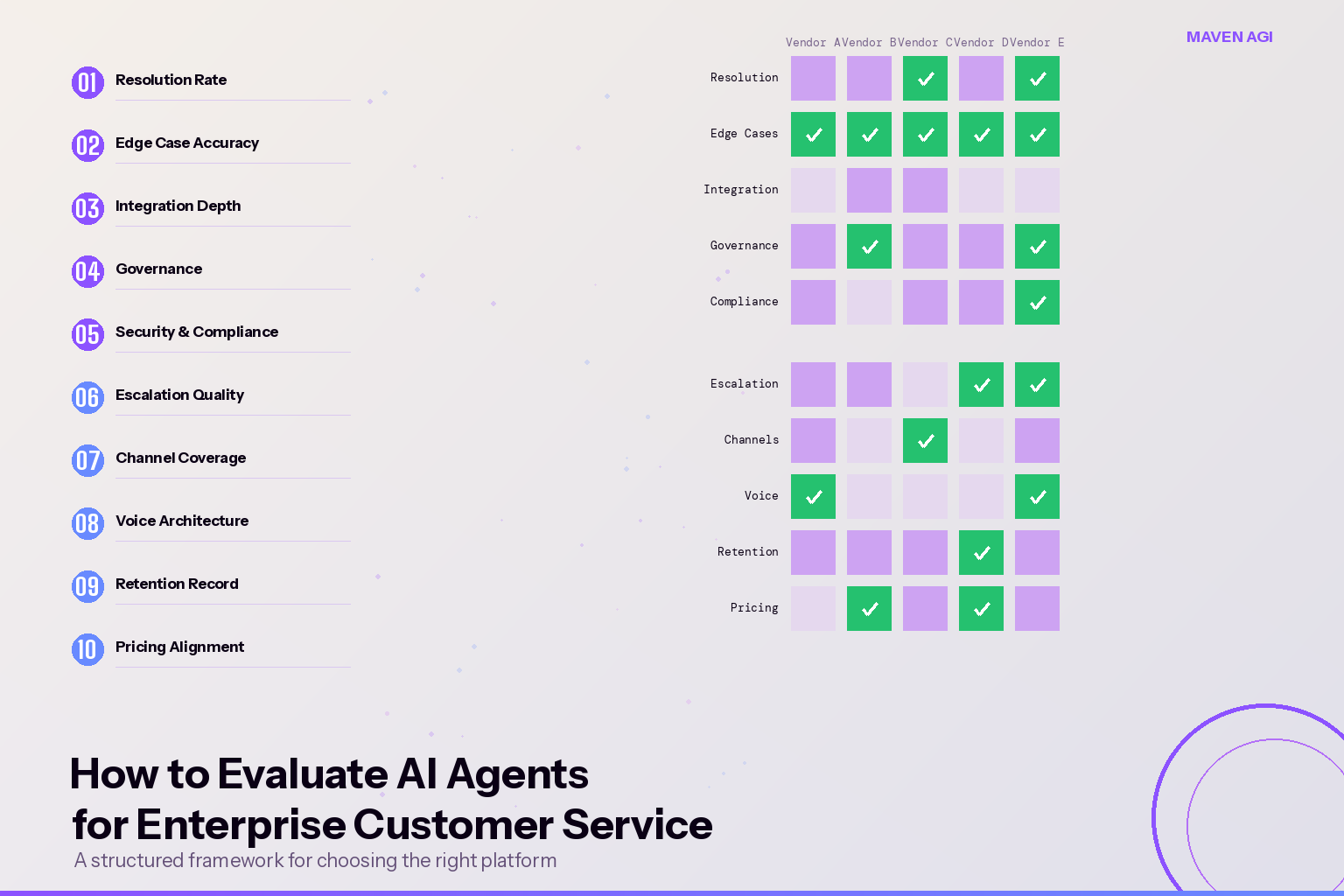
Most AI agent demos look the same. A clean chat window, a friendly answer, a pre-selected question. The differences show up three months later, when your team needs to change a policy, a new channel launches, or the auditor asks how the agent made a decision.
Use this checklist to find those differences before you sign. Each item is a question to put to every vendor, what a strong answer sounds like, and where Maven AGI stands. For the longer reasoning behind the questions, read How to Evaluate AI Agents for Enterprise Customer Service.
How to use this checklist
Score each vendor 0 (no or vague answer), 1 (partial, or roadmap), or 2 (yes, and they can show it in production). Ask for the answer on a live call with your own tickets and your own tools, not in a slide. A vendor that scores 2 on everything in sections 1 to 3 is ready for a proof of concept. Anything below that is a risk you should price in.
1. Results you can verify
- Do they report autonomous resolution, not deflection? Deflection counts conversations the bot touched. Resolution counts conversations where the customer's problem was actually solved with no human. Ask which one the number is, and how it is measured.
- Can they name customers and production numbers? Pilot results and best-case accounts don't count. Ask for a range across customers, with the low end included.
- How fast does resolution improve after launch? A good agent gets better every week from real conversations. Ask for the curve, not the end state.
Where Maven stands: Maven AGI reports up to 93% autonomous resolution in production. Customers include Mastermind at 93%, Clio at 80%, and Papaya Pay, which reached 90% within three weeks of going live. We report resolution, and we are glad to define exactly how we count it.
2. Speed and fit with your stack
- How long from signed contract to live customers? Get a number in days or weeks, and ask what has to happen on your side to hit it.
- Do you have to replace your helpdesk or CRM? Rip-and-replace turns an AI project into a migration project.
- How many integrations are native, and are they read-write? Reading a ticket is easy. Issuing a refund or updating an order is what resolves it.
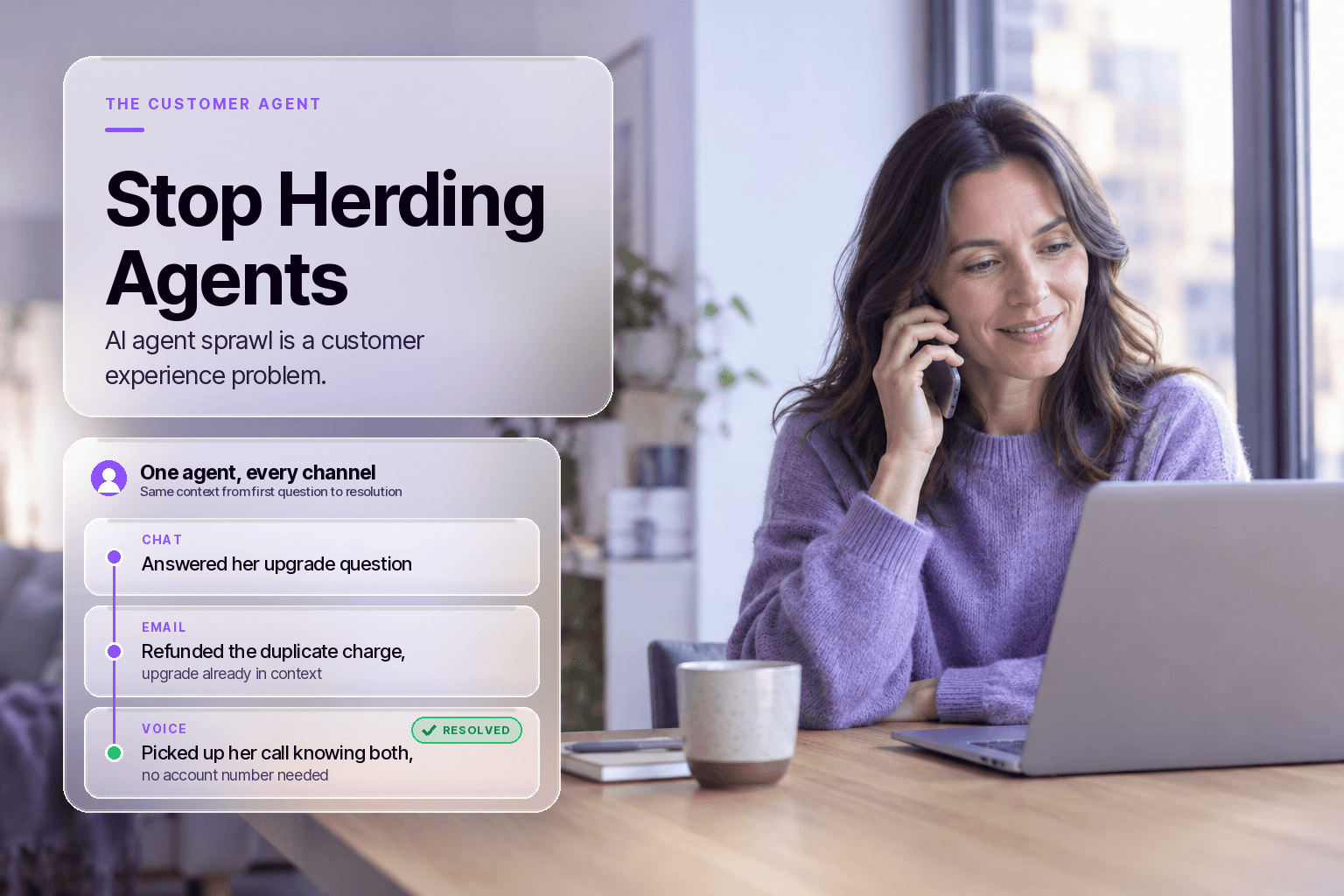
- Which channels run on the same agent? Chat, email, voice, SMS and Slack should share one brain, one knowledge base and one set of rules, not five bots.
Where Maven stands: Maven AGI goes live in days, not months, on top of the tools you already run. It ships with 100+ native integrations, including Zendesk, Salesforce and Intercom, so there is no migration. Chat, email, voice, SMS and Slack run on one agent.
3. Who owns it after launch
- Who makes a change, and how long does it take? If the answer involves a ticket to the vendor or your engineering team, every policy update becomes a queue.
- Can a support lead edit workflows, knowledge and tone without code?
- Can you test a change before customers see it? Look for simulation against real past conversations.
- What do you own if you leave? Ask about your data, your workflows and your knowledge, and in what form you can take them.
Where Maven stands: Maven AGI is built so your CX team owns the agent. Non-technical teams configure workflows, update knowledge and iterate directly, with no engineering tickets and no vendor dependency for each change. Agent Designer is the workspace where that happens.
4. Trust, security and compliance
- Which certifications do they hold today? Ask for current reports, not "in progress." The ones to look for depend on your industry: SOC 2, ISO 42001 for AI management, PCI-DSS if the agent touches payments, GDPR, and HIPAA for health data.
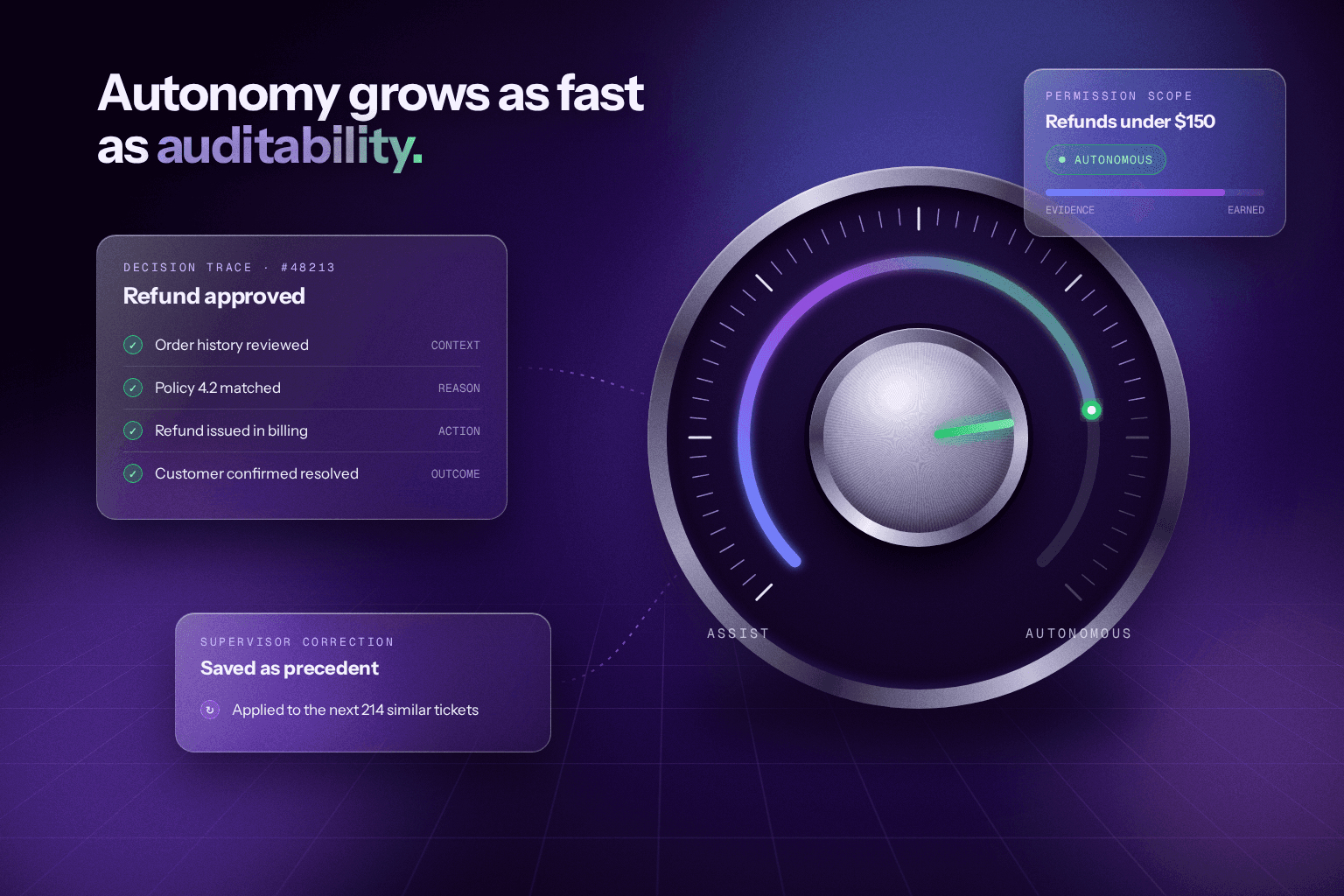
- Can you see why the agent did what it did? Every action and decision should be traceable, so a reviewer can reconstruct a conversation after the fact.
- How do they handle sensitive data and guardrails? Ask where personal data is stored, what is redacted, and how the agent is stopped from going outside its scope.
- Can you switch the underlying model? Models change quickly. A platform tied to one model layer ties your roadmap to that vendor's.
Where Maven stands: Maven AGI holds SOC 2, PCI-DSS, GDPR and ISO 42001, among others, and is vendor-agnostic on the underlying LLM, so you can switch models as the market moves. Decision traces and observability show how the agent reached each answer.
5. Cost you can forecast
- Is pricing published or at least explainable? Ask how price changes as volume grows, and what is excluded.
- What does your team cost on top of the license? Add the people who will configure, monitor and fix the agent.
- What does it cost to change your mind? Customization that locks you in technically and commercially raises the real price.
If you are weighing building your own agent against buying one, use the Own vs. Buy calculator to put the people cost of ownership next to the license cost.
Scorecard
| Area | What a 2 looks like | Maven AGI |
|---|---|---|
| Resolution | Autonomous resolution reported, named customers, low end shared | Up to 93% in production |
| Time to live | Days to weeks, no migration | Days, on your existing stack |
| Integrations | Native, read-write, no helpdesk replacement | 100+ native |
| Channels | One agent across chat, email, voice, SMS, Slack | All five, native |
| Ownership | CX team changes anything without engineering | CX team-owned |
| Compliance | Current certifications you can verify | SOC 2, PCI-DSS, GDPR, ISO 42001 and more |
| Model flexibility | Switch LLMs without a rebuild | Vendor-agnostic |
Questions that end a bad evaluation early
Three questions separate vendors quickly. Ask them in the first call.
- "Show me the resolution rate for your lowest-performing production customer, and how you define resolved."
- "Without your team, how would my support lead change a refund policy on Tuesday and have it live by Wednesday?"
- "Which of my current tools would I have to replace?"
FAQ
What should I look for when evaluating AI customer service vendors? Look at five things: verified autonomous resolution, speed to go live and fit with your existing stack, who controls changes after launch, security and compliance evidence, and a cost you can forecast. The checklist above turns each into questions you can score.
How long should an AI agent implementation take? Days to a few weeks for a platform that deploys on top of your current helpdesk. If a vendor needs months of managed onboarding or wants you to move systems first, treat that as part of the cost.
What is the difference between deflection and resolution? Deflection counts conversations where the customer did not reach a human, even if their issue went unsolved. Resolution counts conversations where the issue was actually solved. Ask every vendor which one their headline number is.
Does Maven AGI work with Zendesk, Salesforce or Intercom? Yes. Maven AGI connects natively to Zendesk, Salesforce, Intercom and 100+ other tools, so you keep the stack you have.
Can my CX team run Maven AGI without engineers? Yes. Maven AGI is designed so CX and operations teams configure workflows, update knowledge and iterate on the agent themselves.
Ready to run this checklist on a live call? Book a demo and we will show Maven AGI against your own tickets and tools.
See it on your own conversations.
Request a free personalized demo.