

Autonomy Is a Dial, Governance Is What Turns It
Most AI agents stall after launch because no one can explain what they’re doing. Auditability is how you get past that.
Most conversations about AI governance in customer service treat it as an obstacle slowing things down. Legal wants a review, security wants another control, and the CX team watches the launch date slide. That picture gets the mechanics backwards.
Consider what happens when governance works as a catalyst instead. Mastermind reached 93% autonomous resolution within six weeks of going live. Papaya Pay hit 90% in just three weeks. Neither team got there by blindly flipping a switch. Instead, they started with an agent handling a clear, well-defined sub-section of tickets, and then steadily expanded its authority as they gained total visibility into its decision-making.
Having a well defined initial deployment is the key to success. Countless AI agents launch, settle at a mediocre resolution rate no leader wants to share with the board, and stay stuck there for a year. Nobody can explain what the agent is doing clearly enough to feel safe letting it do more.
Why AI agent autonomy stalls after launch
Almost every enterprise rollout begins the exact same way. The agent takes on the predictable basics: checking order statuses, resetting passwords, updating plans, and answering straightforward policy questions. Human agents handle the messy exceptions.
Moving past that initial phase means giving the agent power over higher-stakes decisions, like approving an out-of-policy refund. Every time you expand that scope, decision-makers ask one crucial question: "If something goes wrong, will we understand why?"
When the best answer you can offer is a raw transcript and an educated guess, the risk feels too great to manage. The technology may be ready for more, but the business holds it back.
Industry data proves this is a widespread problem. Grant Thornton's 2026 AI Impact Survey of nearly 1,000 senior US executives revealed that 78% lack confidence they could pass an independent AI governance audit within 90 days. Furthermore, while three out of four boards have greenlit major AI investments, only 52% have defined clear governance standards for them.
A Gartner analysis of 432 service and support AI use cases found that a mere 25% deliver positive ROI, while 42% suffer from unclear ROI because leaders simply can’t measure the value produced. Simply put: if you can't trace what an agent does, you can't prove its value, and you definitely can't justify giving it more responsibility.
Governance is the throttle on AI agent autonomy
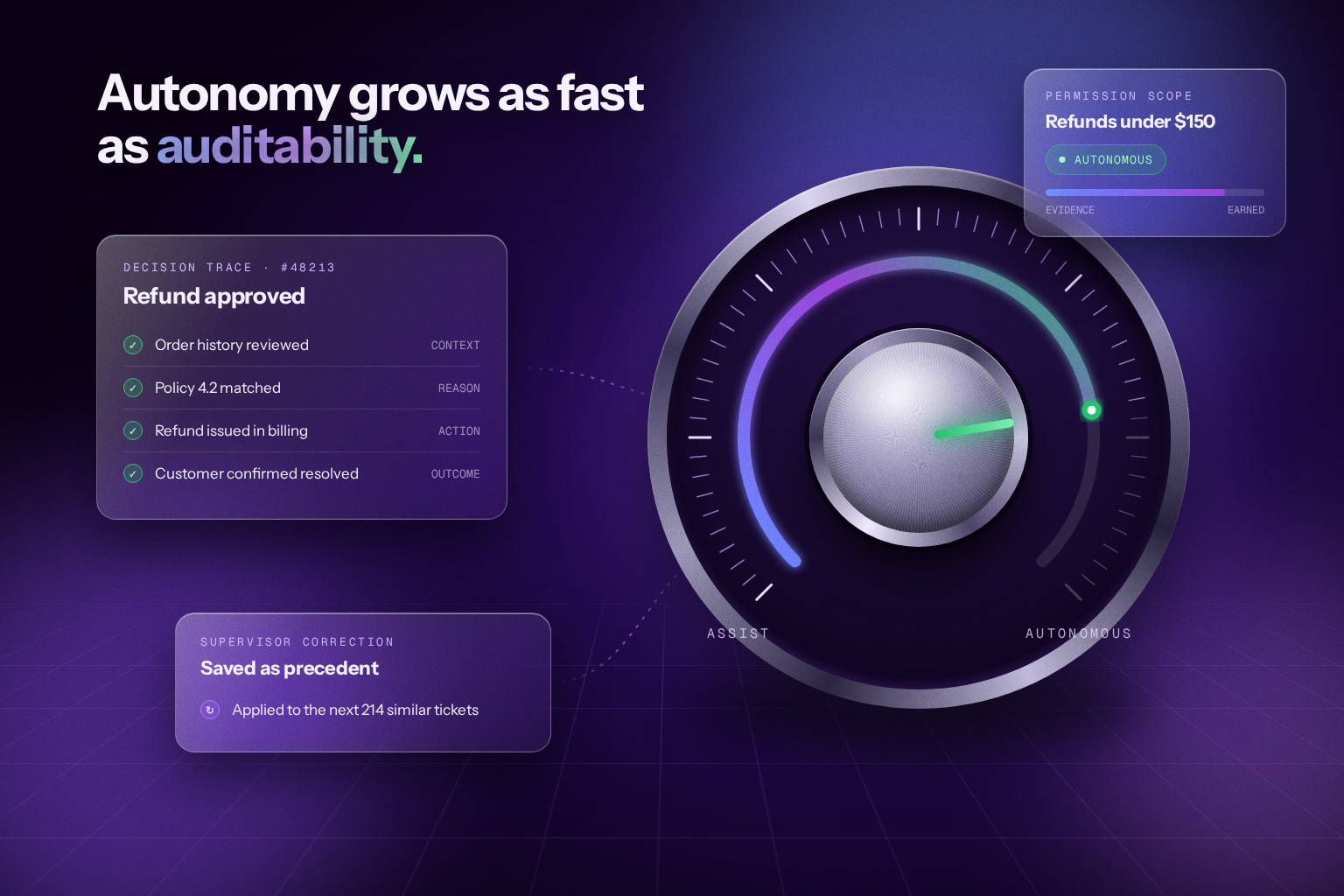
The key to unlocking 90% autonomous resolution isn't pushing harder, it's building total auditability. True auditability means knowing exactly what data the agent evaluated, what action it chose, and why it made that choice for every single interaction. It also means turning human corrections into permanent learning. In short, your agent's autonomy grows only as fast as its auditability.
Building that level of trust requires three core elements working together.
A record of every decision
A typical helpdesk only tracks that a ticket was closed, it completely misses the reasoning behind it. A true decision trace logs the full picture: the customer's situation, the context gathered, the exact step taken, whether it succeeded, and any manual adjustments made afterward. We explored why this complete history is essential in your system of record stores what happened, and it remains the bedrock of scalable AI governance.
Corrections that become precedent
When a supervisor overrides an agent's decision, that correction should immediately update the system's playbook. If feedback gets buried in private ticket notes, you waste valuable human effort repeatedly fixing the exact same errors, and the agent never earns greater independence.
Permissions that widen with evidence
Autonomy shouldn't be a single, global toggle switch. It works best when granted incrementally for specific task types based on proven performance. For instance, issuing refunds below a certain threshold can become fully automated once the agent executes hundreds without errors or reversals. Conversely, high-risk tasks like account closures should remain human-led until the agent proves its readiness over time.
Framed this way, compliance transforms from an annoying bottleneck into a strategic advantage. Official certifications establish the baseline: Maven holds 15 certifications and assessments, including ISO 42001 for AI management systems and PCI-DSS 4.0 Level 1, reassuring security teams that rigorous guardrails are active. Granular, action-level auditability is what empowers operational leaders to confidently approve the next phase of autonomy. If regulatory reviews are slowing you down, pre-staging compliance review accelerates your initial approval process.
What this looks like at scale in a regulated industry
A Fortune 500 gaming enterprise relies on Maven to maintain an 80% autonomous resolution rate across more than 330,000 monthly customer interactions in a heavily regulated market. During peak event traffic, the agent successfully resolved 13,000 tickets in a single day.
Achieving an 80% resolution rate at that scale while meeting strict regulatory standards demands total compliance for every single interaction. You can't reach that level of trust with random spot-checks, clear accountability must be architected into the system from the start.
Crucially, thorough governance doesn't slow down implementation. K1x achieved 80% autonomous resolution one week post-launch. When complete auditability is built directly into the AI agent platform from day one, expanding autonomy becomes a simple data-driven decision rather than a lengthy, repetitive security review.
Questions to ask before you turn the dial
Whether you're currently running an AI agent or preparing to deploy one, evaluate your operations against these key questions before planning your next rollout phase:
Can you reconstruct a single action? Select any refund or account modification from the past week. Can you immediately review what context the agent evaluated and why it chose that specific resolution? If answering that requires an engineer and a full day of research, your autonomy won't scale.
Do corrections stick? Review a ticket where a supervisor overrode the agent. Did the system handle the next similar scenario correctly? If not, your team is stuck doing manual QA on a tool that isn't learning from its mistakes.
Who owns the decision to widen autonomy? Expanding permissions requires explicit approval. Identify who holds that sign-off power and agree on the exact metrics needed to gain their approval before performance plateaus.
What a stuck dial costs
Leaving your AI agent's autonomy locked at its initial launch level costs you twice. You pay the subscription for the platform while continuing to staff the support queues it was built to manage. Your team ends up solving complex issues alongside fixing basic errors made by an unguided agent, while promised ROI flattens into an ongoing expense item.
High-performing CX teams leverage governance as the engine to earn true autonomous resolution, task by task. This aligns directly with Maven’s CEO Jonathan Corbin's core point in Your CRM was built backwards, showing how enterprise customer service successfully transitions from cautious pilots to fully trusted AI capabilities.
Ready to bring action-level auditability to your most complex ticket types? Book a demo today.


Don’t be Shy.
Make the first move.
Request a free personalized demo.