

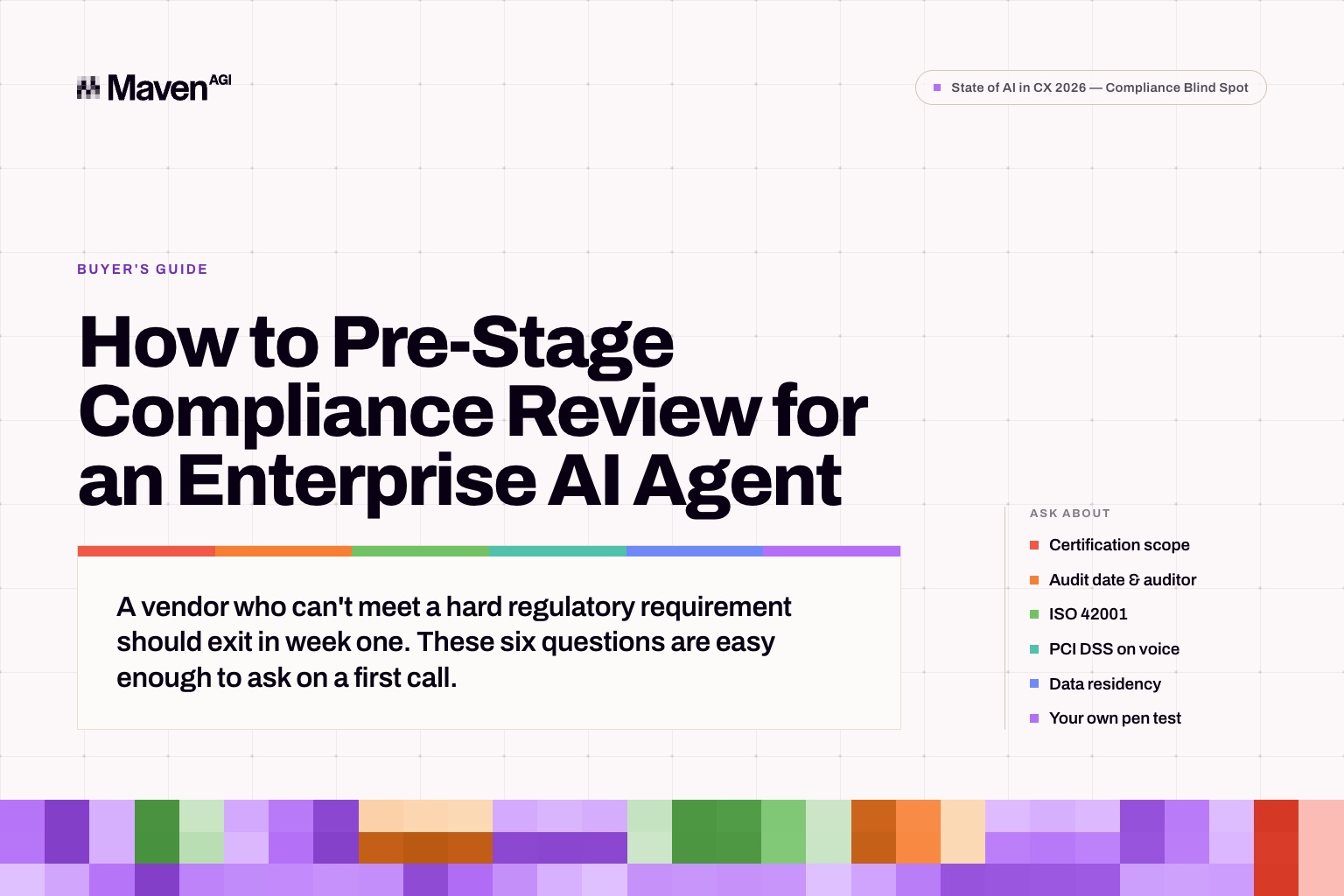
How to Pre-Stage Compliance Review for an Enterprise AI Agent
A vendor who can't meet a hard regulatory requirement should exit in week one. These six questions are easy enough to ask on a first call.
Compliance now stalls enterprise deals at least as often as technical fit does, and buyers who haven’t pre-staged the review typically lose two to three months in mid-funnel. Much of that lost time is avoidable, but the work belongs to you as much as it belongs to the vendor. Pre-staging means having six questions answered before your vendor shortlist is set. Security review should confirm what you already know instead of discovering it.
Ask for certification scope, not just names
A certification name means little without its scope. SOC 2 covering a marketing website is not SOC 2 covering the inference path your customer data travels. So the first question is which certifications the vendor holds and what each one actually covers.
The related substitution to watch for is inheritance. A vendor running on a major cloud platform inherits a great deal of infrastructure security, and some present that inherited posture as their own. Ask for the audit report with the vendor entity named on it. If the entity on the certificate is the hosting provider, you’ve learned something worth knowing early.
Ask when the audit happened and who ran it
Recency and independence both matter, and they fail separately. A current certification audited by a firm with no real independence tells you less than a slightly older one from a recognized auditor. An old certification from a good auditor tells you the vendor was compliant at a point in time that may predate the AI features you’re buying.
Ask for the date and the auditor together. Vendors who produce both quickly tend to produce everything else quickly, which is a signal in itself.
Ask specifically about ISO 42001
This is the question most buyers skip, mostly because it’s so new and uncommon, many don’t even know to ask. Now you know!
Conventional security certifications cover the organization. They confirm a company has policies, trains its people, and manages access. None of them speak to how the AI is governed: whether retrieval is grounded in your knowledge, the model behaves predictably, there’s an audit trail for the actions an agent takes on a customer account.
ISO 42001 is the AI management system standard that addresses exactly that, and a vendor can hold every conventional certification while having no independent assessment of its AI governance. Maven holds 15 certifications and assessments, including ISO 42001, PCI-DSS 4.0 Level 1, SOC 2, HIPAA, and GDPR.
Ask how PCI DSS works on a live voice call
This question separates vendors faster than any other, because voice makes the abstraction concrete. On a call, a customer will read a card number aloud in the ordinary course of asking for help. No interface design prevents it.
PCI-DSS 4.0 Level 1 is the tier that applies at enterprise transaction volume, and the useful follow-ups are all about mechanics. Does redaction happen in real time during the call, or in post-processing afterward? Those are different exposure windows, and only the first keeps the sensitive string out of the pipeline entirely. Is there an audit trail for the redaction itself? Is payment handling segmented from the rest of the conversation?
A vendor who answers in specifics has built their platform for this specifically.
Ask what data residency options actually exist
Ask by region and get specifics, because the terminology here is loose. Regional data residency inside a vendor cloud, private cloud deployment, and customer-hosted deployment are three different commitments that often get described with overlapping language. If your requirement is that the system runs inside infrastructure you control, say so in plain terms and get the answer in writing.
Ask whether you can run your own penetration test
Pair it with a question about internal cadence, because a vendor running adversarial testing quarterly has a different security practice than one that only tests when a customer insists.
The bar is clearable, and clearing it early compounds
A Fortune 500 gaming enterprise runs more than 330,000 monthly interactions on Maven’s autonomous AI agent under regulated-industry constraints, meaning PCI compliance for in-game purchases alongside AML and KYC handling. That deployment scaled rather than stalled, which is what happens when compliance depth is a gate the platform was built to pass rather than a retrofit.
Clio approached its evaluation the same way. The legal software company assessed 32 vendors, narrowed the field, then ran a head-to-head bake-off of more than 10 before choosing Maven. Legal technology carries real confidentiality obligations, and that process is what satisfying them looks like. Clio now runs at 80% autonomous resolution with live support responding 4x faster. Papaya Pay, working under payment regulatory obligations, reached 90% autonomous resolution within three weeks.
None of those cases had compliance review stretch the deployment into a multi-quarter project.
Run this in week one
Most evaluations put compliance near the end. That’s what produces the two-to-three-month loss. A vendor who can’t meet a hard regulatory requirement should exit in week one, and these six questions are cheap enough to ask on a first call.
There is a second reason to do it sooner than later. Compliance answers are unusually good proxies for engineering maturity, because where data lives and how the system works are the same question viewed from different angles. Vagueness about the first is usually vagueness about the second.
The six questions in condensed form are in The AI Compliance Buyer's Checklist, drawn from the Compliance Blind Spot chapter of the State of AI in CX 2026 report.

Don’t be Shy.
Make the first move.
Request a free personalized demo.