

Charters gets a shortcut and a safeguard
Two updates make building Agents faster and safer: Charter Templates and Strict Return Charters.
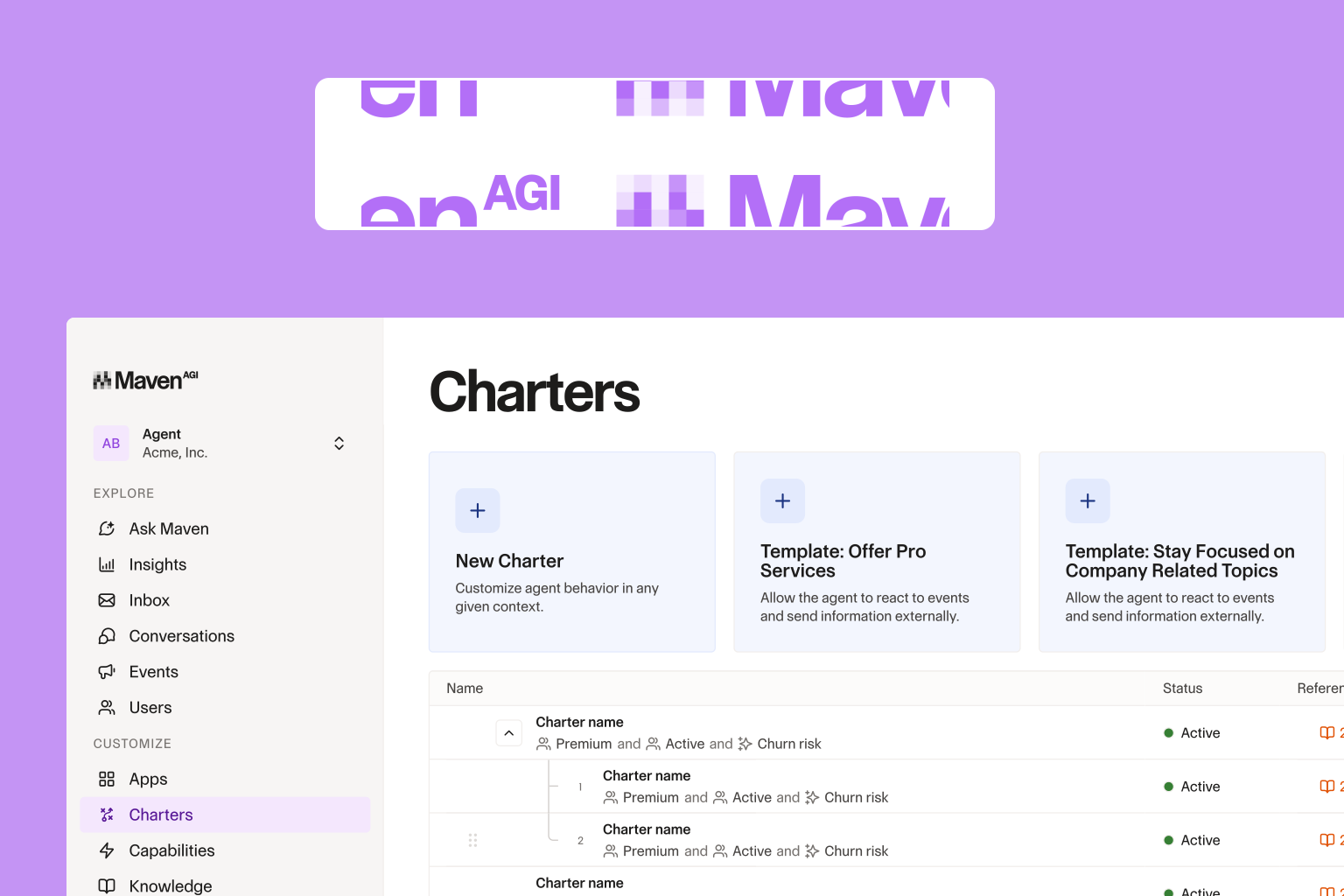
Charters launched last month as the fix for how a Maven agent gets its instructions: one governed structure that decides what the agent knows, does, and is allowed to say, based on who it's talking to and what's happening. Instead of one giant instruction set carried into every conversation, a Charter tree breaks that down into situation-specific playbooks, so an upsell moment, a refund request, and a compliance-sensitive question each get exactly the behavior they should.
We hear from our customers that two things slow their Agent building process, and they sit at opposite ends of the maturity curve. Teams building their first agent stare at an empty Charter tree with no idea where to start, and lose days to a decision that should take a few minutes or hours. Teams further along are sitting on a different worry: a legal disclosure, a refund policy, generated every single time, with no guarantee it comes out the same way twice.
Two updates make building Agents faster and safer: Charter Templates and Strict Return Charters.
Charter Templates: skip the blank page
Building a Charter tree from scratch used to mean staring down a decision: what should this thing actually look like? For a team standing up their first agent, that's an open question with no wrong answer and no obvious right one either, and it's the reason a first agent can take weeks longer to launch than it should.
Charter Templates replace that blank page with a set of tested starting configurations for common use cases, including baseline setup and escalation flows. Instead of building a Charter tree from first principles, a team picks the template closest to their use case and adjusts from there. The structure is already proven. What's left is customization, not invention.
This matters most for teams building their first agent, or their fifth agent in a new use case they haven't configured before. The gap Charter Templates closes isn't a technical one. It's the time and uncertainty between "we want an agent for this" and "we have a working Charter tree we trust."
Strict Return Charters: eliminate the wording risk
Most Charters let the model reason through a response inside a defined structure. Strict Return Charters remove that step entirely for the responses where it doesn't belong. A Strict Charter returns one fixed, pre-approved answer, with no generation involved. If the Charter fires, the customer gets exactly the text that was written and approved, every time.
That distinction matters for anything where legal, compliance, or brand teams need certainty rather than confidence. Today, even a well-built agent is generating language for these moments, which means there's always a small surface area for drift, and that surface area is exactly what keeps compliance teams from signing off on more autonomy. Strict Return Charters closes that surface area for the specific responses where it can't be tolerated, without requiring a separate system or a workaround outside the Charter tree.
One foundation, any level of AI maturity
Charter Templates and Strict Return Charters aren't a new way of working with Maven. They extend the same Charter tree model introduced at launch: a team's first agent and a fully governed, compliance-critical one are built on the same foundation, just configured differently. There's no separate system to learn for teams that need stricter guarantees, and no rebuild required as a team's needs grow.
That's the throughline for both of these updates, and for Maven's approach more broadly: the platform should work the same way whether a team is standing up its first agent or managing dozens of them under regulatory review.
Want to see how fast a first agent comes together with Charter Templates? Talk to us.


Don’t be Shy.
Make the first move.
Request a free personalized demo.