

How to Evaluate AI Agents for Enterprise Customer Service
A vendor-neutral framework for how to evaluate AI customer service platforms, built around the questions that separate production-ready vendors from the ones that only demo well.
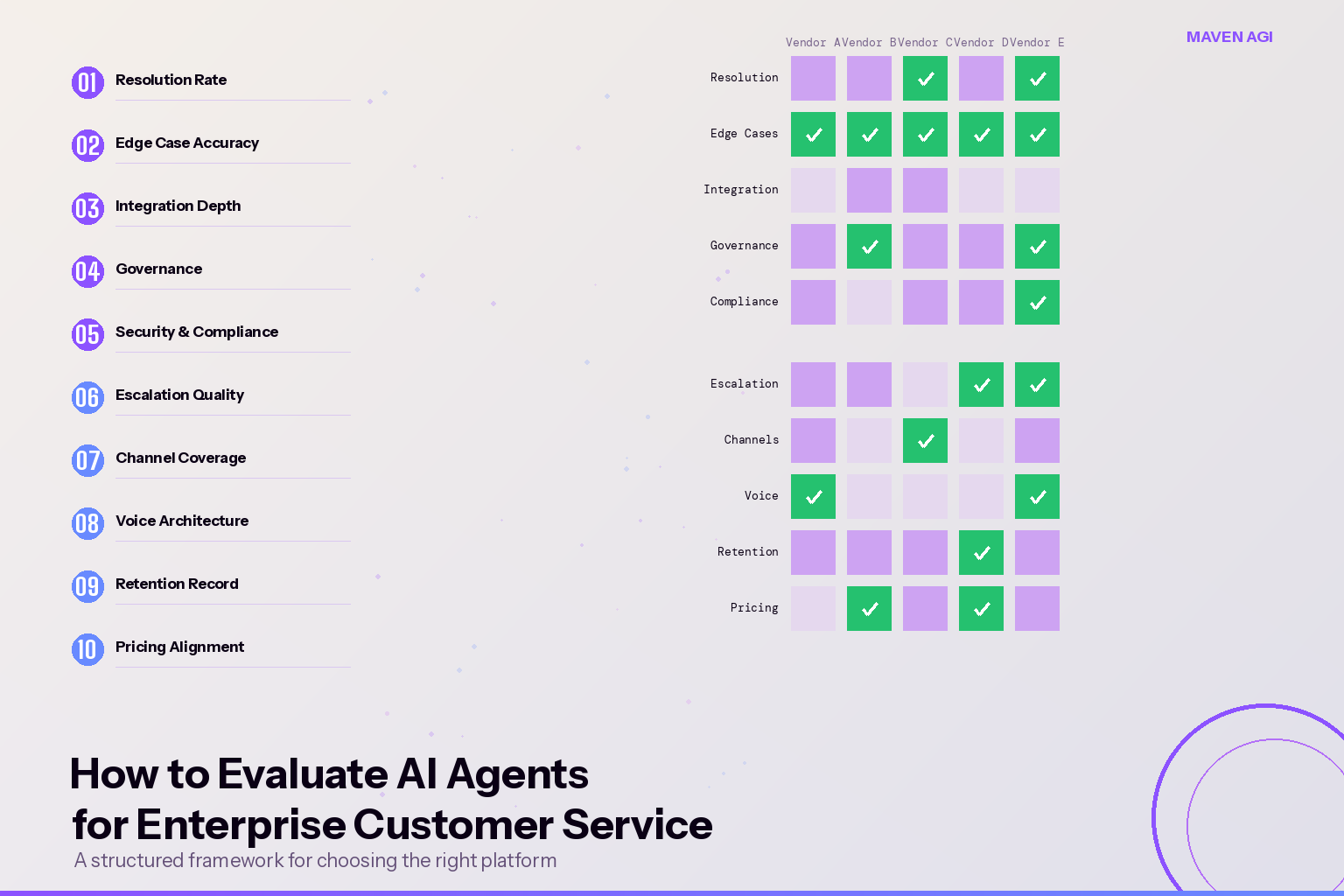
The enterprise AI agent market has matured to the point where there is no shortage of vendors claiming strong results. Proof-of-concept environments regularly produce the headline numbers, 80% or 90% automation rates, and yet deployments that maintain those results in production are considerably rarer. The gap is predictable if you know what to look for, and it is largely invisible if you run a standard evaluation.
The difference between the teams that get this right and everyone else is not the demo. It is whether they pressure-tested the platform on the variables that decide production performance. This guide is a practical answer to how to evaluate AI customer service platforms without being fooled by a polished first impression, and how to choose the best AI customer service platform for an enterprise deployment that has to hold up under real volume. It is built around the questions that distinguish platforms built for production from platforms built to demo well. If it helps to anchor on the customer service use cases you actually run, start there and work backward to the criteria.
Start by understanding what you are actually evaluating
Most vendor evaluations start with a demo request and end with a reference call. That process was designed for software that does what it is configured to do. AI agents are different: their performance in a controlled demonstration often has limited predictive value for production performance. The variables that matter most in production, query distribution, edge case frequency, integration reliability, and behavior under load, are exactly the variables that demos are set up to avoid.
Before you run any evaluation, it is worth getting clear on three things.
What does resolution mean for your use case? Not deflection, not containment. Autonomous resolution means the customer’s problem was solved, they did not come back about the same issue, and the AI took the action without needing a human to finish it. If you cannot define this specifically for your product before the evaluation starts, any benchmark the vendor provides will be hard to interpret.
What does failure look like? An AI agent that handles 80% of interactions well but mishandles the other 20% in ways that damage trust is not a deployment win. Knowing your failure modes, wrong refunds, incorrect account changes, escalations that lose context, lets you build those into the evaluation rather than discovering them after launch.
What is your integration reality? The performance gap between sandbox and production almost always traces back to integration. An agent evaluated on a sample of your knowledge base will behave differently than one connected to your live CRM, ticketing system, and billing platform. The earlier you can test with real system access, the more predictive the results.
The questions that surface production capability
Standard vendor evaluations tend to cluster around features and pricing. These questions are designed to surface something more specific: whether the platform is designed for how enterprise support actually works.
How do you define autonomous resolution, and how do you measure it? The answer tells you more than any benchmark. Vendors with genuine production experience have specific definitions and specific measurement methodologies. They distinguish between tickets closed by the AI, tickets deflected to self-service, and tickets that reached a human. Vendors optimizing for demo performance tend to conflate these. Ask them to walk through how a resolved ticket gets classified versus a deflected one in their system.
What is your re-contact rate within 72 hours? This is the metric that exposes false resolution. If a significant share of interactions marked resolved result in the same customer contacting support again within three days, the effective resolution rate is lower than the headline number. This is the same distinction that separates deflection from resolution. Production-focused vendors track it. Vendors who do not are measuring the wrong thing.
Can the agent take actions in my backend systems, or can it only surface information? Read-only versus read-write integration is the architectural dividing line. An agent that can tell a customer their order is delayed but cannot reschedule the shipment is not resolving the issue, it is answering a question. For most enterprise support use cases, genuine resolution requires write access to at least two or three backend systems. Ask which integrations are available through prebuilt connectors and which require custom development.
How does escalation work, and what happens to context? The escalation moment is where most AI deployments create friction rather than remove it. When the agent hands off to a human, does the human receive a summary of the conversation and the customer’s account history, or does the customer start over? Test this specifically during evaluation. It is the interaction most likely to generate complaints, and the one most often glossed over in demos.
What does the agent do when it does not know? Graceful failure is as important as strong performance. Watch how the system handles queries outside its training, ambiguous requests, and intentional attempts to produce bad output. Vendors confident in their handling of these cases will let you probe them during evaluation. The ones who steer away from these tests usually have a reason.
How long does integration take? If the honest answer is months, that is useful information. Enterprise deployments that require extended professional services engagements before going live carry significant cost and risk. An overlay architecture that connects to existing helpdesks without requiring data migration can often go live in weeks. Ask for specific timelines from signed contract to first live interactions.
The proof-of-concept trap
POCs are nearly universal in enterprise AI evaluations, and they almost always produce better results than production deployments. This is not a coincidence. POCs run on clean data, limited query scope, and vendor-side support. They are tuned for the evaluation. Production deployments run on the full distribution of customer queries, connected to systems that were never designed to work with AI, and managed by teams who have other jobs.
To close this gap, push for POC conditions that actually resemble production. Run it on live queries from your actual customer base, not a sample. Connect it to production-equivalent systems, not a sandbox. Run it long enough to see performance stabilize, not just the initial tuned window. Ask what percentage of queries during the POC were within the pre-configured scope versus outside it. Most pilots that look good in a demo never reach production, and the reasons are consistent enough to plan around; the breakdown of the pilot-to-production gap covers what separates the two.
The vendors willing to run a POC under those conditions are the ones building for production. The ones who insist on controlling the conditions closely are optimizing for the POC itself.
What a rigorous evaluation looks like in practice
The strongest evaluations come from teams that treat vendor selection as an engineering decision, not a procurement formality. When Clio, the legal-tech platform, set out to replace a legacy scripted bot, the team evaluated 32 vendors, then ran a head-to-head bake-off of more than 10 before choosing Maven. They tested against their real requirements: accurate answers to in-app chat inquiries, deep integration with their existing stack including Salesforce, and performance on the edge cases that break scripted systems.
The result held up in production, not just in a demo: 80% autonomous resolution, with 4x faster live support for the technical questions that still reach a human. That combination, high autonomous resolution paired with faster handling of the exceptions, is the signature of an evaluation that is tested for production rather than for a polished first impression. It is also what the strongest CX teams have in common. They design the evaluation to find the failure points before signing, not after.
Compliance is not an add-on
For most enterprise deployments, the path from POC to production runs through your security review. This is where many AI agent evaluations stall or fail entirely. The compliance requirements for an AI agent that autonomously handles customer data, processes transactions, and takes actions in production systems are substantial, and most organizations are not as ready as they think. In a 2026 Grant Thornton survey, 78% of leaders said they lack confidence they could pass an AI audit within 90 days.
Evaluate compliance posture early, not as a final checkpoint. Specifically: whether the vendor holds SOC 2 Type II, HIPAA BAA availability, GDPR data processing agreements, and PCI-DSS compliance for any payment-adjacent workflows. Whether audit trails are available and queryable for every agent action. Whether the vendor’s subprocessors have been evaluated and disclosed. Whether the platform can operate within your data residency requirements.
Vendors with genuine enterprise compliance infrastructure will answer these questions with documentation, not assurances. The ones who treat compliance as a late-stage checkbox are the ones most likely to fail security review after you have already invested in the evaluation.
The reference call you should be asking for
Most vendor reference calls are structured to confirm positive experiences. Ask instead for a reference call with a customer who had a difficult deployment, one that required significant troubleshooting before it performed well. How the vendor handled that deployment tells you more than three smooth ones.
Specifically ask the reference what went wrong, how long it took to resolve, and whether they got the support they needed. The answers determine whether you will want to be working with this vendor eighteen months into a production deployment.
Run the evaluation that predicts production
Every vendor can clear a demo. Far fewer can clear an evaluation designed to expose what happens at real volume, on real systems, under a real security review. Use these questions as a scorecard, run the POC on your hardest queries, and weight production references over analyst badges. The teams that do this consistently are the ones whose deployments still perform a year later.
See how the framework holds up against your own ticket volume. Book a demo and bring the queries you expect to break it.

Don’t be Shy.
Make the first move.
Request a free personalized demo.