

Stop Herding Agents: AI Agent Sprawl Is a Customer Experience Problem
Why managing fragmented AI agents hurts CX, and how a unified customer agent solves sprawl across channels.
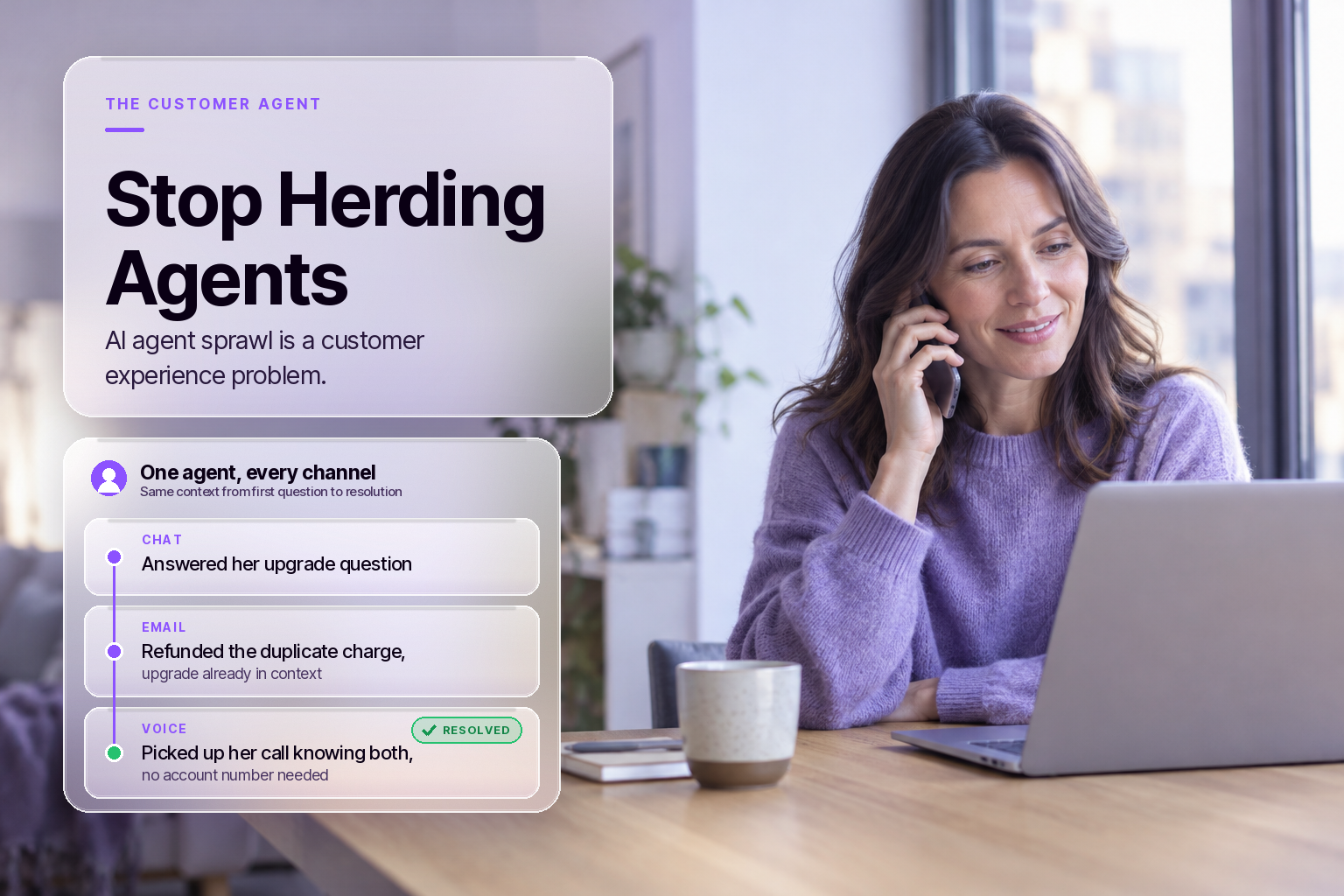
A customer asks the agent on your website about upgrading her plan. Two days later she emails about a duplicate charge, and a different agent replies. The next week she calls to cancel, and the voice agent opens by asking for her account number. Each of those agents might have handled its own task well. She still told her story three times, and she's the one deciding whether to renew.
That's AI agent sprawl, seen from the customer's side. Most of the sprawl conversation so far has belonged to IT and focused on governance, credentials and shadow AI. For CX leaders the cost lands somewhere less visible, in the distance between how connected your stack looks on a vendor diagram and how disconnected it feels to the person trying to get something done.
The average enterprise is already running a fleet
MuleSoft's 2026 Connectivity Benchmark Report, which surveyed 1,050 enterprise IT leaders, puts the average at 12 AI agents per organization, with that number expected to grow 67% within two years. Half of those agents operate in isolated silos rather than as part of a coordinated system.
IT leaders see it coming. In OutSystems' 2026 State of AI Development survey of roughly 1,900 IT leaders, 94% said they're concerned that AI sprawl is increasing complexity, technical debt and security risk. Only 12% have a centralized platform to manage it.
None of this happened through bad decisions. Agents got bought the way enterprise software always gets bought, one department at a time. Support picked an agent to work the queue. Sales added one for inbound leads. Billing's came bundled with the payments platform, and voice went out as its own RFP. Each team chose sensibly for its own metric, and nobody owned what the customer experienced across all of them.
Customers feel the seams more than leaders think
A ServiceNow survey of Canadian consumers and executives, published in April 2026, shows how wide the perception gap runs. 44% of customers said having to repeat their issue or re-enter information frustrated them, while only 15% of executives thought it was a problem for customers. Being transferred between departments bothered half of customers, compared with 27% of executives.
A handoff between AI agents is a transfer, even without the hold music. If the second agent doesn't know what the first one learned, the customer starts over, and how quickly the new agent responds doesn't change how that feels.
What the customer agent does differently
The customer agent is Maven's answer to sprawl: one agent that knows each customer from the first question through renewal, on every channel.
In practice, the agent that answered a pricing question in chat is the same agent that picks up when the customer calls about an invoice, with the full history in hand. It works across chat, voice, email, SMS, WhatsApp, Slack and Teams from a single engine, in 54 languages in chat and 57 in voice-to-voice. A customer who switches channels doesn't also switch to a less informed version of your brand.
It also runs as an overlay. The customer agent connects to the helpdesk you already use, whether that's Zendesk, Salesforce or Freshdesk, and to existing telephony like Twilio, Vonage, Cisco and Genesys. Consolidating agents doesn't require ripping out the systems those agents were plugged into. [Link: /product/agent-platform]
The measure changes too. A department-level agent reports its own containment number. The customer agent is accountable for autonomous resolution [Link: glossary page] of whatever the customer actually came for, which might be a refund, a fixed integration, a completed upgrade or a renewal that didn't slip away. Resolution Rate across the whole relationship is a harder number to hit than twelve separate dashboards, and it's the one your customers are already grading you on.
Coordinating twelve agents is still running twelve agents
The usual response to sprawl is an orchestration layer that routes between specialized agents and passes context along. That helps IT see what's running. It helps the customer less, because every handoff passes a summary, and summaries lose detail. The billing agent learns a dispute exists. It may not learn that the customer mentioned three messages earlier that she's evaluating alternatives.
Each additional agent also brings its own permissions, guardrails and audit trail. For teams working under SOC 2, HIPAA, PCI-DSS or the EU AI Act, that multiplies the surface you have to secure and explain to an auditor. One agent means one policy set to govern, one audit trail to review and one place to enforce controls like real-time PII redaction during live calls. Maven carries 15 certifications and assessments, including ISO 42001 for AI governance and PCI-DSS 4.0 Level 1, and that coverage means more when it applies to the single agent your customers talk to than to one of twelve.
What a single engine looks like in production
Clio, the legal technology company, evaluated 32 vendors and put more than 10 through a head-to-head bake-off before choosing Maven. Its global deployment reached 80% autonomous resolution and made live support 4x faster. [Link: Clio customer story]
Mastermind reached 93% autonomous resolution within six weeks of deployment. K1x was live at 80% resolution in its first week. Rho held 95% CSAT while absorbing 12% more monthly contacts.
What those deployments share is one agent holding the knowledge, the actions and the history, with resolution as the measure from day one. [Link: /resources/deflection-vs-resolution-the-metric-that-decides-whether-ai-customer-service-actually-works]
Questions to ask before you add agent number thirteen
If you're building your 2027 AI roadmap, put these to every team that wants its own agent:
- When a customer moves from chat to phone, what does the second agent know about the first conversation?
- Who owns the outcome when a single customer journey crosses three agents?
- How many separate policy sets, permissions and audit trails will your compliance team review next year?
- Are you measuring resolution per agent, or across the whole customer relationship?
If those answers are uncomfortable now, a thirteenth agent will make them harder.
Stop herding agents
Your customers don't see your org chart, and the agent serving them shouldn't depend on it either. The customer agent gives every customer one agent with complete context, from first question to renewal, on every channel they use. [Link: /solutions/customer-service]
See how it works at mavenagi.com/explore/stop-herding-agents, or book a demo to map what consolidating your agents would look like in your stack.

Don’t be Shy.
Make the first move.
Request a free personalized demo.