

Magi: the expert helper that knows your Agent, helps you fix it, and keeps you in control
Meet Magi, the new AI assistant for Maven. In the product, in your AI tools, and in your terminal.

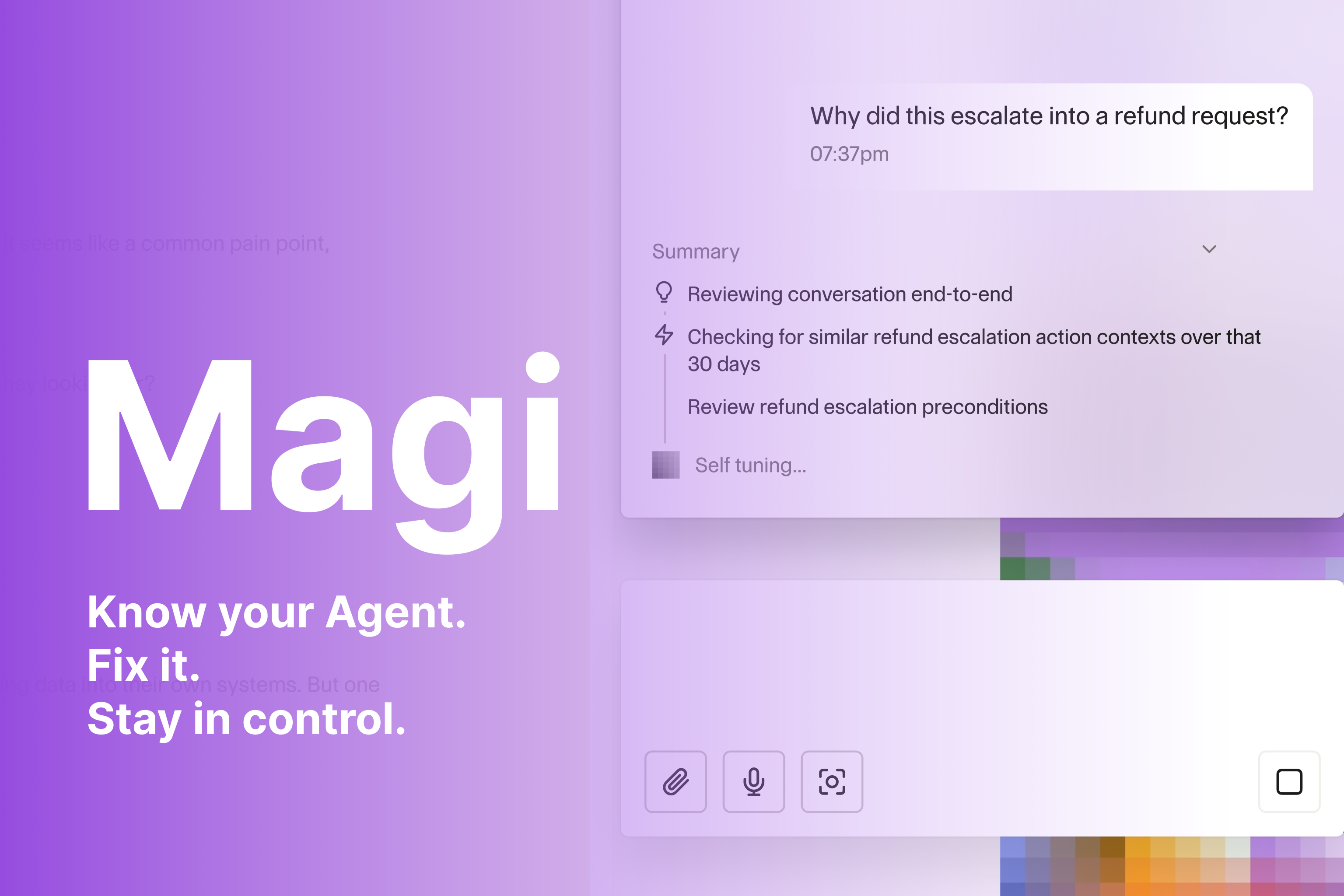
Most teams running agents in production can't tell you, with confidence, whether their agent is actually working.
They can tell you the containment rate. They can show you a dashboard. But ask why the agent answered a specific customer the way it did, and things get quiet. Someone files a ticket for engineering. Someone digs through logs. A few days later, you might get an answer.
That delay costs more than time. The teams getting the most out of AI tend to be the ones who understand it best. McKinsey found that companies seeing the biggest bottom-line returns from AI, those attributing at least 20% of EBIT to it, are more likely than others to follow practices that make their AI explainable. Understanding your agent isn't a nice-to-have. It's how you get the value out of it.
So why does understanding an agent still take an engineer? And why does acting on what you learn, like updating a policy or tightening a guardrail, still take someone who knows their way around the configuration?
We believe building and managing an agent shouldn't require immense technical expertise. That belief is why we built Magi.
Meet Magi
Magi (pronounced MAG-ee) is a new AI assistant for Maven. You talk to it in plain language, the same way you'd talk to the smartest person on your team. It does three things.
- It watches. Ask Magi anything about your agent's data. What are customers asking about most this week? Where is the agent struggling? What changed since last month? You get answers without writing a query or waiting on a report.
- It explains. Point Magi at a conversation and ask why. Why did the agent make that decision? Why did it escalate here and not there? Magi walks you through the reasoning in plain language, not logs.
- It drafts. Ask Magi to draft a set of guardrails for a new policy, or to help configure your agent based on what it just found. Magi does the heavy lifting of figuring out what should change and putting it together for you.
Magi goes where you work
The same insights and actions are available wherever your team already works, so the answer to "why is the agent doing this?" is never more than a question away.
- In Maven. Magi lives right inside Agent Designer, next to the agent you're working on. Understand what you're looking at, ask questions in context, and move from insight to improvement without leaving the page.
- In your AI tools. Magi connects to the AI assistants your team already uses, like Claude, through MCP. That means your CX team can pull Maven data into the work they already do, from analysis to QBR prep to building the slide or the doc, alongside the other tools they've connected.
- In your terminal. Developers and solutions engineers can work with Magi from the command line through Magi CLI. Pair it with a coding assistant like Claude Code and describe what you need in plain language. You can inspect how an agent is wired, pull conversations, or clone a full agent configuration across agents and environments in minutes.
One Magi, three front doors. Whether you're a support leader, a CX manager, or an engineer, you get the same understanding of your agent, in the place that makes sense for you.
You still hit save
Magi never changes your configuration without you. Every change it proposes waits for your review and approval.
That's a deliberate choice. An agent that builds agents is only as valuable as your confidence in what it builds. In an enterprise, "the AI changed it" is not an acceptable answer to "why is the agent doing this?" So Magi handles the investigating and the drafting, and you keep the decision.
Agent Ops for everyone
Getting an agent live is a milestone. Keeping it good is the job. We call that job Agent Ops.
If you've worked in software, you know DevOps: the idea that shipping code isn't the finish line, and that running and improving it is a discipline of its own. Agent Ops is the same idea for AI agents. It's the ongoing work of monitoring how your agent performs, understanding why it behaves the way it does, improving it as policies change and new questions come in, and governing what changes and who approves it. Without it, an agent slowly drifts away from what the business needs. With it, the agent gets better every week it's live.
Until now, Agent Ops has mostly been a technical job. Magi changes who gets to do it. Here's what that looks like in practice. Say you notice a conversation that escalated into a refund request, and it shouldn't have. A CX manager asks Magi, "Why did this escalate into a refund request?" Magi reviews the conversation end to end, checks for similar refund escalations over the last 30 days, and compares the charters involved. It spots the cause: the agent's configuration passes a conversation into a refund escalation any time a customer mentions a health issue, and that logic has fired in 137 conversations in the last 30 days. Magi drafts revisions to the Foundations, Subscription Troubleshooting, and Refund Help charters that narrow when a refund escalation should happen. The manager reviews the changes, approves them, and the next customer who mentions a health issue gets helped instead of escalated. Before Magi, fixing this would have taken days. Someone would spot the problem, file a ticket, and wait for a technical resource to trace the logic across charters. With Magi, it takes one conversation, and the person who spotted the problem is the one who fixes it.
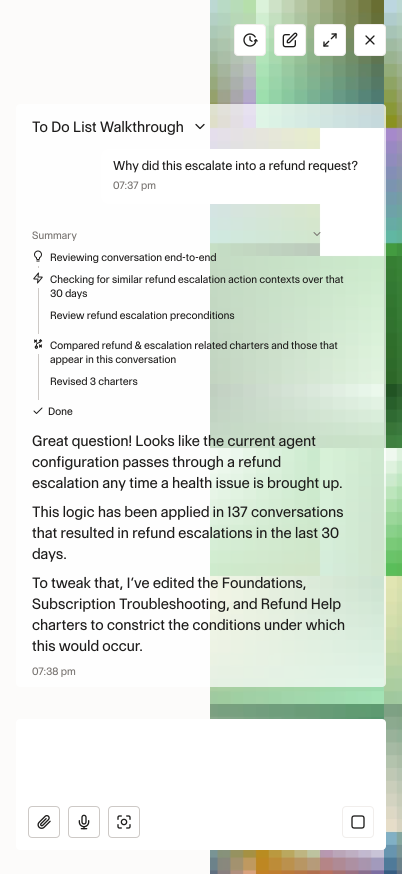
That's Agent Ops for everyone: understand what's happening, figure out what to change, and keep improving. The result is an agent that gets better because the people who know your customers best are the ones shaping it.
Join the waitlist
We can't wait for you to try Magi. We're keeping a few things under wraps until launch. Let's just say watching, explaining, and drafting is where Magi starts, not where it ends.


Don’t be Shy.
Make the first move.
Request a free personalized demo.