

What Is Agentic AI in Customer Service?
Nearly every service team is doing something with AI right now, but far fewer can tell you exactly what agentic means.
Agentic AI describes software that chases a goal on its own instead of just responding to one instruction at a time. In customer service, that means an AI agent reads what a customer wants, figures out the steps to get there, calls whatever systems hold the answer or can take the action, and checks that it actually worked, without a person steering every step. The real question when you’re comparing vendors isn’t “does it use AI,” it’s whether the software just shuffles work around or actually finishes it.
Nearly every service team is doing something with this right now, but far fewer can tell you exactly what the category means.
Gartner expects more than 40% of agentic AI projects to get canceled by the end of 2027 because of rising costs, unclear payoff, and weak risk controls (Gartner press release, June 25, 2025). That same research found only about 130 of the thousands of vendors calling themselves “agentic“ actually meet the definition. Gartner calls this agent washing. On the buyer side, McKinsey found roughly 80% of companies have rolled out generative AI, but about the same share see no real impact on earnings (McKinsey, Seizing the agentic AI advantage, June 13, 2025).
So agentic AI clearly works somewhere, one vendor’s own forecast has it autonomously resolving 80% of common service issues by 2029 (Gartner, March 5, 2025). What you need is a way to tell the systems that’ll actually get there apart from the ones that will spend eighteen months routing tickets more elegantly than before.
What an agentic system is made of
Six parts. Most vendors are strong in two of them and vague about the rest.
- Perception. Reading the request and extracting what it actually asks for, across text, voice, and images.
- Reasoning and planning. Breaking a goal into steps and deciding their order. This separates an agent from a script.
- Memory. Short-term memory so it knows where it is mid-task, plus longer-term memory so it knows who it’s talking to and what happened last time.
- Tool and action layer. The actual connections into your systems: pulling up an order, issuing a credit, changing a subscription. Without this, the system can only describe a refund, not give one.
- Orchestration. Coordinating multiple agents or steps and passing context between them. Standards are starting to solidify here (Model Context Protocol for tool access, agent-to-agent protocols for coordination).
- Guardrails and escalation. Knowing what not to do, and knowing when to stop and hand off to a person with full context attached.
These parts work in a loop, not a straight line: perceive, plan, act, check, adjust. A scripted flow just runs once and either works or breaks.
What gets confused for agentic AI
Four other categories get labeled “agentic” in vendor pitches. They’re all doing real work, but none of them actually resolve anything.
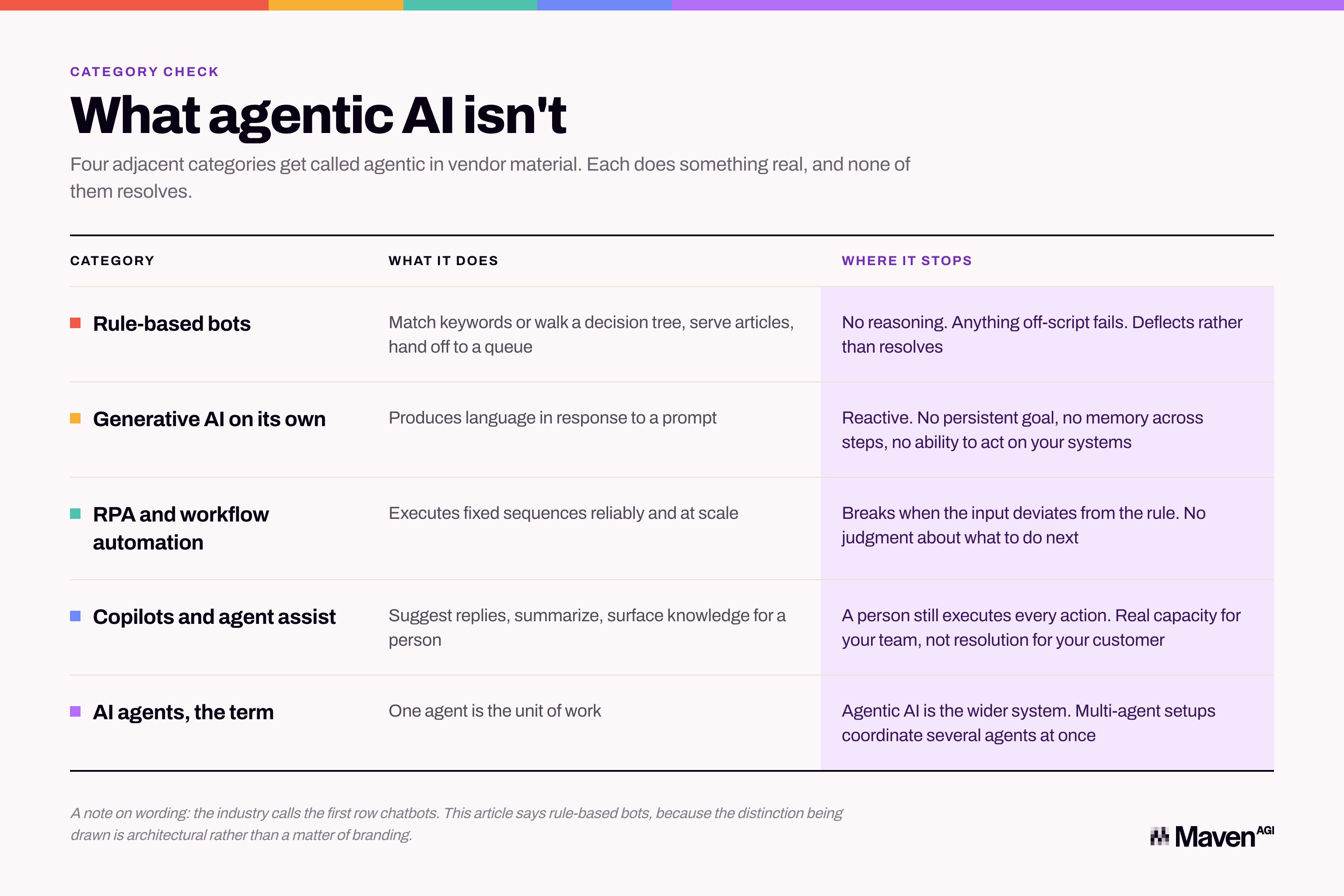
Quick note on terms: the industry usually calls the first row “chatbots.“ This article calls them rule-based bots instead, since the real difference is architecture, not branding.
Orchestration is not resolution
This is where most of the confusion lives, so let’s be blunt about it.
The agentic use cases you see most in production, routing, triage, escalation handling, workflow orchestration, personalization, are all real work. None of them resolve anything. A system that reads a ticket, classifies it correctly, pulls the right account context, and routes it to the right queue has done something genuinely useful, but it hasn’t solved the customer’s problem. Orchestration speeds up your existing process. Resolution actually takes work off your plate.
This is also where the measurement language gets slippery. Three terms get used interchangeably that really shouldn’t be:
- Deflection rate. The share of contacts handled without a person. Easy to inflate, since customers who simply gave up or got stuck in a loop look the same as a success in the log.
- Containment rate. The share of conversations that stayed in the automated channel. Says nothing about whether the issue got fixed.
- Resolution rate. Whether the issue was actually settled, confirmed by no re-contact within 24–48 hours, or by asking the customer directly.
Only that third number reflects an actual customer outcome. If a vendor gives you a number without saying which of the three it is, that’s the first thing to ask.
What resolution looks like when it works
The specific situation matters more than the headline number, because every service leader’s objection is “our environment is more complicated than that case study”. So here’s what constraint each of these teams was actually working under:
K1x runs tax and legal document workflows with a small support team and zero appetite for a long IT project. The system layered on top of what they already had instead of replacing it, which is what made a fast rollout possible, they hit 80% autonomous resolution in their first week live.
Clio sells legal practice software to a global customer base and didn’t take anyone’s word for it. They evaluated 32 vendors and ran a head-to-head test of more than ten before picking one. Result: 80% autonomous resolution and live support four times faster.
Rho, a fintech company, had contact volume rising with no extra headcount coming. The goal was just keeping up without the experience getting worse, they held 95% CSAT while handling 12% more monthly contacts with the same team size.
A Fortune 500 gaming company operates in a regulated space with volume that spikes hard around events. Normal volume is 330,000+ monthly interactions at 80% resolution, and on one peak event day the system resolved 13,000 interactions.
Exclaimer wanted the ticket queue itself to actually shrink, not just move faster. It dropped 18%, with 15% more responses handled autonomously and over ten hours a week given back to the team.
What autonomy level you are actually buying
Autonomy-level frameworks are starting to firm up. The Cloud Security Alliance put out a six-level model in January 2026, and most other versions agree on the shape even if they use different labels.
In practice, most enterprise deployments sit at conditional autonomy, the system handles the whole task within a defined boundary and escalates anything outside it. If a vendor claims more than that, they’re describing a roadmap, not a product.
A refund example makes this concrete: at conditional autonomy, the system reads the request, checks it against policy, verifies eligibility against the order, issues the credit if it’s within the threshold, and hands it off to a person with full context if it’s not. You set that threshold, and that setting, not the underlying model, is what really determines how much the system does.
Five questions that separate the two categories
- What does the system actually do, not just say? Ask for the specific list of actions it can take in your systems. If the answer is all about answering questions, it’s orchestrating, not resolving.
- How is resolution defined and verified, deflection, containment, or confirmed resolution, and over what time window?
- What happens when confidence is low? A system with no real escalation path is just guessing.
- What does setup actually require from your team? Weeks of a vendor’s solutions architect is a very different ask than weeks of your own engineers’ time.
- Which named customers in your industry, at your volume, will actually talk to you? One reference call in a comparable environment tells you more than any benchmark stat.
Frequently asked questions
What is agentic AI in customer service?
Software that pursues a service goal on its own, it reads the request, plans the steps, acts on the systems holding the data, and confirms the result without someone directing each move. The key trait: it finishes the task instead of just routing it.
How is agentic AI different from a chatbot?
A rule-based bot matches input to scripted answers and punts anything unfamiliar to a human. An agentic system reasons through an unfamiliar request, figures out what steps would fix it, and carries them out on live systems. One deflects; the other resolves.
Is agentic AI the same as generative AI?
No. Generative AI just produces text in response to a prompt. Agentic AI uses a generative model as one piece of a bigger system that also plans, remembers, and acts. Buying generative AI and expecting agentic results is a common mistake.
Can an AI agent issue a refund or change an order?
Yes, if it’s connected to the systems that perform those actions and allowed to do so within set limits. Most companies set a threshold and send anything above it to a person.
What is a good resolution rate for AI in customer service?
Depends on the channel, the complexity, and how you’re measuring it. Real production numbers range from about 50% to 93%. Ask any vendor exactly how they define and verify their number before comparing it to someone else’s.
Will agentic AI replace human agents?
Today’s systems run at conditional autonomy, handling defined work and escalating the rest. So far, the pattern is more capacity: the same team handles more volume, and spends more of their time on the stuff that actually needs judgment.
Is agentic AI compliant with PCI DSS and HIPAA?
Compliance comes from the platform, not the category. Ask for specific certifications, whether they cover voice, and how personal data gets handled in real time.
Why do agentic AI projects fail?
Gartner points to rising costs, unclear payoff, and weak risk controls. Underneath all of that, the real problem is usually buying something that orchestrates and expecting it to resolve.


Don’t be Shy.
Make the first move.
Request a free personalized demo.