

What’s Changed One Year Since Gartner’s “80% AI Resolution” Prediction That Rattled the Industry?
A year ago, Gartner predicted 80% autonomous customer service by 2029. Here’s what’s changed, what hasn’t, and what it means for your AI strategy in 2026.
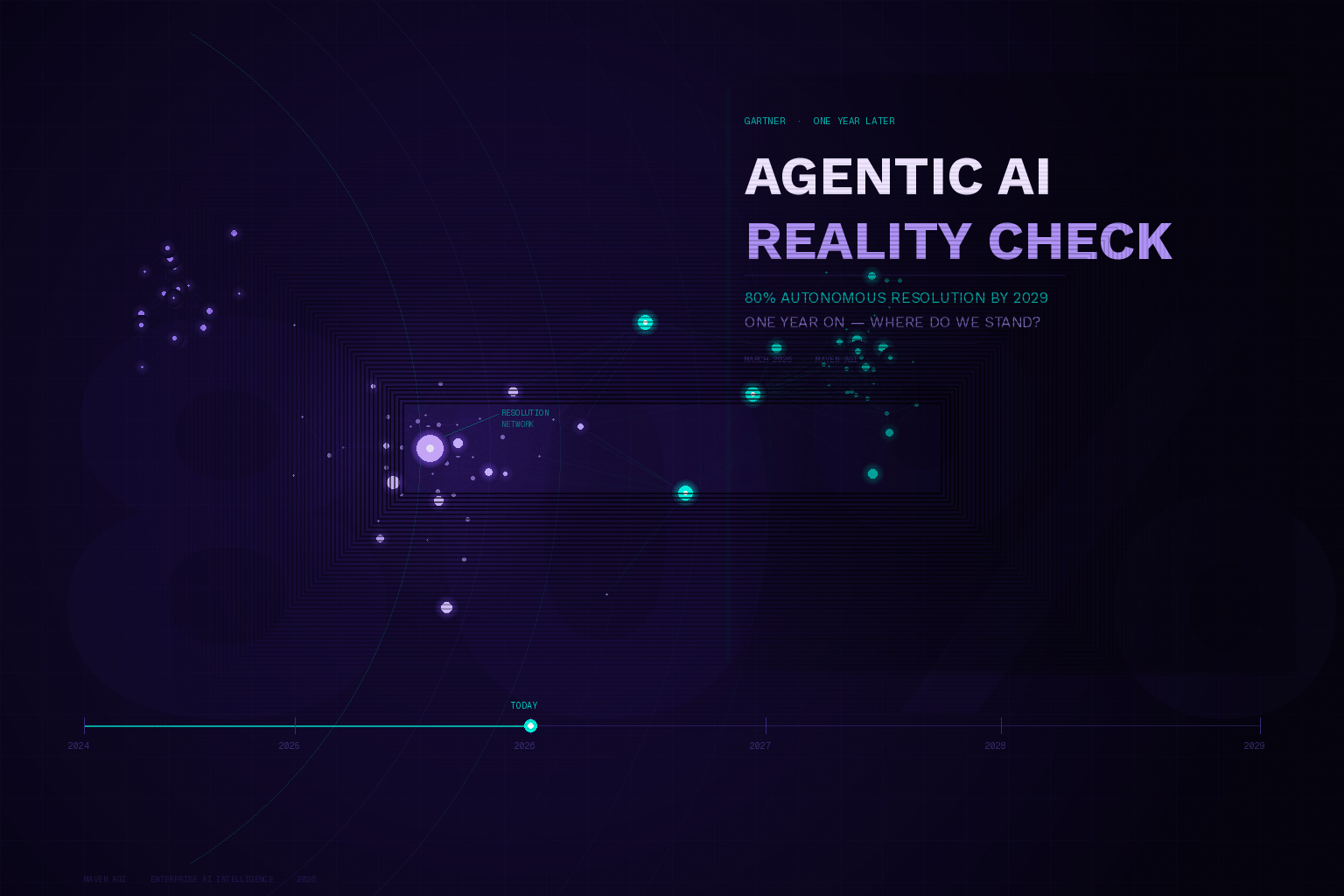
In March 2025, Gartner made a prediction that lit up every CX leader's strategic planning deck: by 2029, agentic AI will autonomously resolve 80% of common customer service issues without human intervention, cutting operational costs by 30%.
It's been a year and a lot has happened. Some of it validated the prediction, some of it complicated it considerably. Some of it revealed problems that nobody was talking about twelve months ago.
If you're building an AI strategy for customer service in 2026, the March 2025 headline doesn't give you the full picture anymore. You need the corrections, warnings, and market data that followed.
The original prediction: what Gartner actually said
The core claim was straightforward: agentic AI would move beyond generating text and summarizing conversations into autonomously completing tasks. Memberships canceled. Shipping rates negotiated. Issues fixed before the customer even noticed them.
The 80% number was the headline, but the 30% cost reduction was the one that got CFOs involved. The framing was important: Gartner wasn't talking about chatbots getting smarter. They were describing a fundamental shift in how service organizations operate. From reactive, human-driven queues to proactive, AI-driven resolution.
That prediction landed in a market that was ready to hear it. Budgets moved. Pilots launched. Vendors scrambled to position themselves.
Then the reality checks started arriving.
Three months later: Gartner's own course correction
By June 2025, Gartner published a significantly more cautious follow-up: more than 40% of agentic AI projects will be canceled by the end of 2027. The reasons were stark — escalating costs, unclear business value, and inadequate risk controls.
This wasn't a reversal of the March prediction, it was a filter. Gartner was essentially saying: yes, 80% autonomous resolution is where this market is going. But most of you are going to fail getting there.
A January 2025 poll of over 3,400 enterprise leaders told the story in numbers. Only 19% had made significant investments in agentic AI. Another 42% were making conservative bets. The remaining 39% were either waiting, unsure, or hadn't invested at all. The market was moving, but it was moving cautiously — and the early movers were already hitting walls.
The agent washing problem nobody anticipated
Perhaps the most important development in the past year was Gartner naming a phenomenon that enterprise buyers were experiencing but couldn't articulate: agent washing.
Of the thousands of vendors claiming agentic AI capabilities, Gartner estimated that only about 130 were real. The rest were rebranding existing chatbots, RPA tools, and virtual assistants with new marketing language but no meaningful new capabilities.
This matters enormously for CX leaders evaluating vendors right now. A chatbot that's been relabeled as an agent will still hit the same ceiling it always did. Somewhere around 20–30% of interactions are handled, with no ability to reason across multi-step problems, coordinate across channels, or take autonomous action within enterprise systems. When that relabeled chatbot underperforms, the buyer blames agentic AI as a concept rather than the vendor who oversold them.
This is a significant chunk of where the 40% cancellation rate comes from. Companies aren't failing at agentic AI. They're failing at procurement. They're buying chatbots dressed up as agents and wondering why the results look the same as last year.
What actually accelerated: the numbers that held up
Not everything that happened in the past year was a warning sign. Several data points confirmed that the underlying trend is real and accelerating. For the companies doing it right.
Enterprise app integration surged. In August 2025, Gartner predicted that 40% of enterprise applications would integrate task-specific AI agents by the end of 2026, up from less than 5% the year before. We're now in the window where that prediction gets tested, and the adoption curve looks aggressive. Enterprise software vendors across CRM, helpdesk, and ERP have all shipped agent capabilities in the past twelve months.
Multi-agent AI became a competitive differentiator. By October 2025, Gartner's strategic predictions stated that organizations using multi-agent AI for 80% of customer-facing processes will dominate by 2028. The companies that figured out how to coordinate multiple AI agents across functions, not just a single chatbot on a single channel, are the ones pulling ahead.
Cisco independently confirmed the timeline. Cisco's 2025 global survey of nearly 8,000 business and technology leaders projected that over 56% of customer support interactions will use agentic AI by mid-2026, rising to 68% by 2028. This isn't one analyst firm talking. Multiple independent surveys converge on the same window.
B2B buying is going agent-first. Gartner predicted that by 2028, 90% of B2B buying will be AI agent intermediated, pushing over $15 trillion in spend through AI agent exchanges. This means your customer service AI won't just be talking to humans, it will be negotiating with other companies' AI agents. If your platform can't handle machine-to-machine interactions, you're building for a world that's already passing.
What changed: the workforce conversation got real
In December 2025, Gartner published survey results that shifted the conversation from technology to people. Over 80% of organizations said they expect to reduce contact center headcount in the next 18 months, through attrition, hiring pauses, or layoffs.
But the more interesting number was this: nearly 80% of those same organizations are planning to transition existing agents into new positions, and 84% are adding new skills to agent profiles.
This is a more nuanced picture than the AI replaces agents headline suggests. What's actually happening is a restructuring. Routine interactions move to AI. Human agents handle the complex, high-empathy, high-judgment cases. And the role itself evolves from answer the phone and follow a script to supervise AI, handle escalations, and manage exceptions.
For CX leaders, this means your AI strategy is also a workforce strategy. You can't deploy agentic AI in a vacuum and expect the org chart to sort itself out. The companies getting this right are the ones who planned the workforce transition alongside the technology deployment, not after it.
What stayed the same: the architecture problem
Here's what hasn't changed in the past year: the fundamental architecture gap that separates companies on track for 80% resolution from those heading for the cancellation pile.
Most agentic AI pilots still start in a single channel. Usually chat, sometimes email, rarely voice. Almost never all three at once. The logic seems reasonable: start small, prove value, expand later. But customer service doesn't work in channels. It works in issues.
A customer calls your support line, gets impatient, sends an email, then opens a chat window two hours later. Same issue, three channels, three separate AI agents that have no idea about each other. That's not an autonomous resolution. That's automated fragmentation.
The companies that are actually reaching autonomous resolution rates above 90% are doing it with unified architectures: one AI agent that sees the full customer history across every channel, integrates with the existing helpdesk rather than replacing it, and hands off to humans with full context when needed. No asking for your account number again. No starting over because you switched from phone to chat.
This was true a year ago. It's still true. And the 40% cancellation rate is largely a story about companies that ignored it.
The compliance wall is still standing
The other thing that hasn't changed: enterprise compliance remains the single biggest blocker between a successful pilot and a production deployment.
Gartner's most recent strategic predictions for 2026 added a new wrinkle. By the end of 2026, death by AI legal claims will exceed 2,000 due to insufficient risk guardrails. That number should focus the mind of any CX leader evaluating AI platforms. The cost of getting compliance wrong isn't just a failed pilot anymore. It's legal exposure.
Healthcare companies handling PHI. Financial services handling PCI data. Every company handling PII under GDPR. An AI agent that autonomously resolves customer issues needs to operate within SOC 2, HIPAA, GDPR, and PCI-DSS frameworks as a core capability, not a roadmap item. Five ISO certifications, SOC 2 Type II, HIPAA BAAs — these are the differences between a pilot that scales and a pilot that dies in security review.
What to actually do with all of this
A year of data hasn't changed the destination. Gartner's 80% prediction still looks directionally right. What the year has clarified is which paths lead there and which ones lead to the 40% cancellation pile.
Audit your vendor for agent washing. If your AI vendor's agent can't autonomously plan, execute multi-step tasks, and coordinate across channels without human prompting, you don't have an agent. You have a chatbot with better marketing. Only about 130 vendors out of thousands are offering genuine agentic capabilities, according to Gartner's own estimate.
Build unified, not single-channel. If your AI can't see the customer's phone call when they switch to chat, you're measuring channel automation, not issue resolution. The 80% target is about issues resolved, not conversations handled. That requires unified resolution across chat, voice, and email.
Plan the workforce transition now, not after deployment. The data is clear: headcount will shift, but roles will evolve rather than vanish. Design the new roles, training, and career paths alongside the technology rollout.
Require compliance on day one. With AI-related legal claims projected to exceed 2,000 by the end of this year, retrofitting compliance is no longer a timeline risk. It's a legal risk. Choose platforms built for enterprise security from the start.
Measure autonomous resolution, not deflection. Deflection counts conversations the AI touched. Autonomous resolution counts issues it actually solved, across all channels, from first contact to closure. The second metric is the one that maps to the 80% prediction. The first one is the one that makes bad pilots look good on paper.
Where this leaves us
Gartner's March 2025 prediction was right about the destination. The past year filled in the map, and the map shows that most of the roads people are taking don't actually get there.
The companies that will reach 80% autonomous resolution by 2029 aren't the ones who moved fastest. They're the ones who moved correctly: unified architectures, genuine agentic capabilities, enterprise compliance baked in, and a workforce plan that treats AI as a restructuring, not a replacement.
The ones who bought relabeled chatbots and single-channel pilots? They're the 40%.
You have three years before the 80% prediction gets scored. How you spend the next twelve months determines which side of that number you're on.


Don’t be Shy.
Make the first move.
Request a free personalized demo.