

The Most Credible Proof in AI Customer Service Isn't a Vendor Claim
When buyers run the test themselves, the results speak louder than any sales deck.
Every enterprise AI agent platform on the market reports a high resolution rate. Read enough vendor decks and the numbers start to blur together. That's the quiet problem with the category right now: when everyone claims the same kind of result, buyers stop believing any of it, and the figure that should matter most fades into background noise.
There is one exception. A number stops being marketing the moment a customer produces it themselves, under their own conditions, with their own customers on the other end. That's the difference between a vendor saying its agents resolve most issues and a buyer running the test and having most issues resolved.
Thumbtack ran the test itself
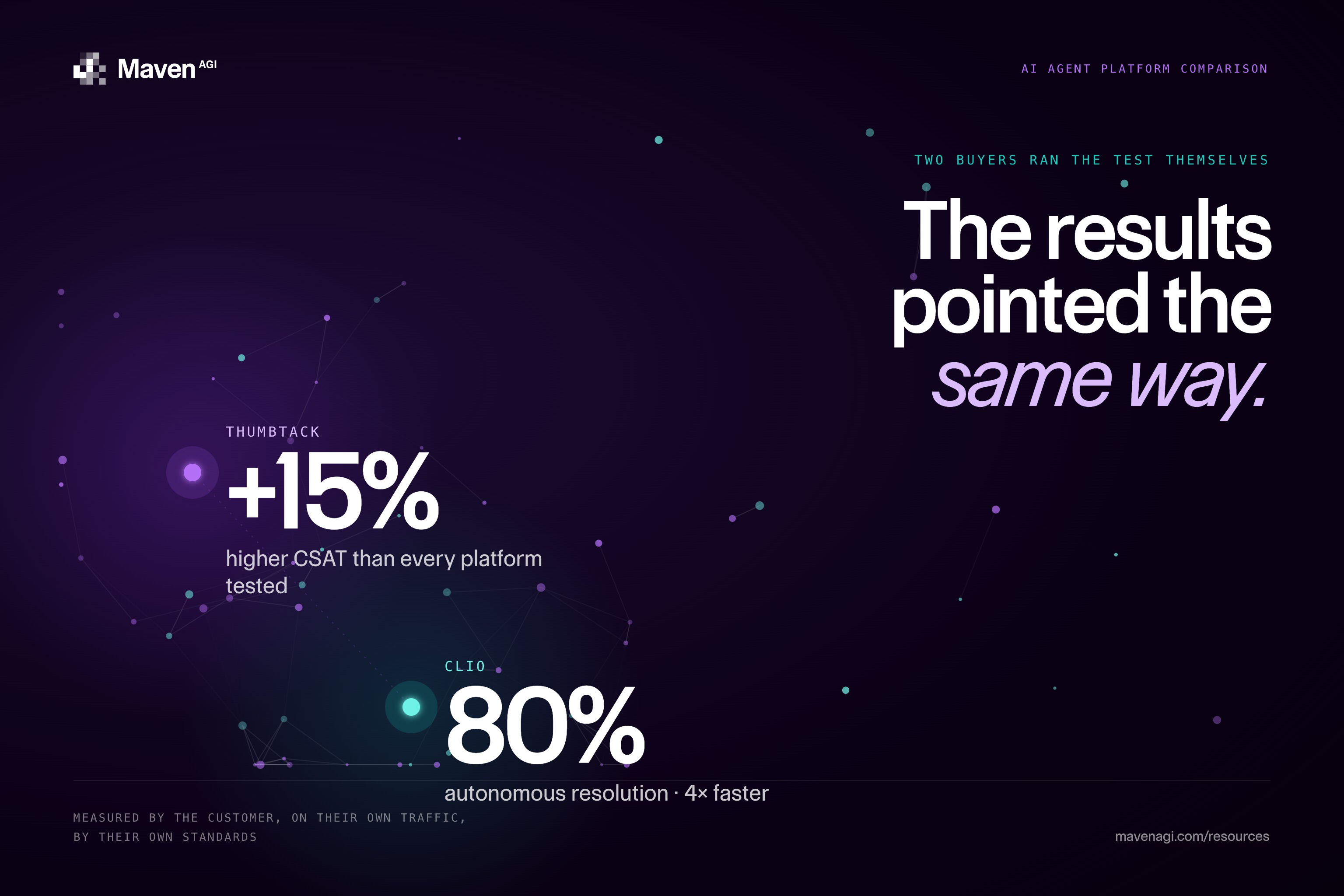
Before committing, the Thumbtack team ran a head to head benchmark of the leading AI agent platforms, measuring each one against the same live support traffic. Maven came out with CSAT scores more than 15 percent higher than every competitor in the comparison.
The detail worth sitting with is who ran it. This wasn't a number Maven reported about itself — it was a result Thumbtack measured, on Thumbtack's volume, against Thumbtack's own satisfaction baseline. The platforms in the test didn't get to stage the conditions. The buyer did.
Why a buyer-run test carries more weight
A vendor demo is a controlled environment. The questions are known, the data is clean, the awkward edge cases are quietly left out. None of it tells you how a platform behaves when a frustrated customer asks something the script never anticipated, at 11pm on a holiday weekend.
A customer benchmark strips that control away. Real tickets arrive in whatever shape customers send them. Satisfaction gets scored by people who don't care which vendor wins. The platform either resolves the issue and leaves the customer satisfied, or it doesn’t.
This is also what separates the strongest CX teams from the rest. They don’t pick an enterprise AI agent on feature checklists or analyst grids alone. They define the outcome they care about, autonomous resolution and customer satisfaction, then they measure it on their own traffic before signing anything.
The pattern repeats with Clio
Thumbtack isn't the only buyer to work this way. Clio, the legal technology company, evaluated 32 vendors, narrowed the field to a head to head bake-off of more than 10, and then chose Maven. The deployment reached 80 percent autonomous resolution and made live support four times faster.
Two companies, in different industries, with very different support profiles, ran independent evaluations and arrived at the same place. One result is a fluke. Two is a pattern. Neither outcome depended on taking a vendor's word for it.
What this means for your own evaluation
If you’re evaluating AI agent platforms right now, the takeaway is less about Maven and more about method. The buyers who get this right do four things in common.
- Define the metric before the demo. Hold every vendor to the same definition. A resolution rate that quietly counts deflection is not the same number.
- Test on live traffic, not curated samples. How a platform handles your messiest tickets is the only behavior that predicts production.
- Score satisfaction against your real baseline. A CSAT lift only means something relative to what your customers experience today.
- Weight a measured head to head over a polished pitch. The vendor with the best deck and the vendor with the best results are not always the same company.
Run an evaluation like that and the marketing claims sort themselves out. Platforms that only perform in controlled conditions show it fast once real customer support traffic starts hitting them.
The metric customers actually feel
What Thumbtack and Clio measured wasn’t how many conversations could be pushed away from a human. It was how many customer problems actually got resolved, and how people felt afterward. That kind of number holds up because customers feel it directly. Get it wrong and the cost shows up somewhere real: satisfaction scores, repeat business, the trust that's slow to rebuild once it slips.
For a CX leader sorting through vendor claims, the lesson from both companies is the same. The platforms worth shortlisting are the ones willing to be measured on your traffic, by your standards, with your customers scoring the result. Anything else is still just a claim.

Don’t be Shy.
Make the first move.
Request a free personalized demo.