

Deflection vs. Resolution: The Metric That Decides Whether AI Customer Service Works
Your AI vendor’s automation rate might be hiding the number that actually matters: the AI customer service resolution rate.
Nearly one in five consumers who have used AI for customer service say the experience gave them no benefit at all. That finding, from the Qualtrics 2026 Customer Experience Trends Report, landed in the same year vendors were announcing 50%, 60%, even 80% automation rates.
Both numbers can be true at once. The gap between them comes down to a single word: deflection.
Deflection counts interactions the AI touched. Autonomous resolution counts problems the AI actually solved. Your AI customer service resolution rate is the distance between those two figures, and that distance is where customers get lost and where CX leaders make expensive decisions on the wrong data.
What deflection actually measures
When a customer submits a question and the system answers with a link to an FAQ article, most platforms log that as a successful deflection. The ticket never reached a human. The automation rate ticks up. The dashboard looks healthy.
The dashboard doesn’t know whether that customer found their answer. It doesn’t know if they gave up, called back the next day, or quietly churned. Deflection measures what the AI did. It says nothing about what the customer experienced.
This problem gets worse as deployments scale. A 2026 NewtonX study surveyed 2,000 consumers and 500 enterprise CX decision-makers across three continents, and the split was stark: businesses optimize for cost reduction and ticket deflection, while consumers value resolution above everything else. Resolution ranked seventh among the outcomes businesses said they prioritized.
The same study found that 55% of businesses measure AI and human agent performance together, which makes it nearly impossible to isolate how the AI is actually performing. When you can’t separate the signals, you can’t tell whether your AI is resolving issues or just absorbing volume.
The gap, in one number
The clearest read on how wide this runs comes from Gartner research now cited across the industry: AI deflects more than 45% of customer queries, but only around 14% reach full self-service resolution. That is a 31 point gap between what the dashboard reports and what the customer actually got.
For every hundred questions the AI touches, roughly fourteen end with the customer’s problem solved. The other thirty-one were counted as handled without being fixed. Those are the contacts that come back as re-contacts, escalations, and churn, and they are why a healthy-looking automation rate can sit on top of an unhealthy operation.
The math that makes deflection dangerous
Here is how that plays out in a single month.
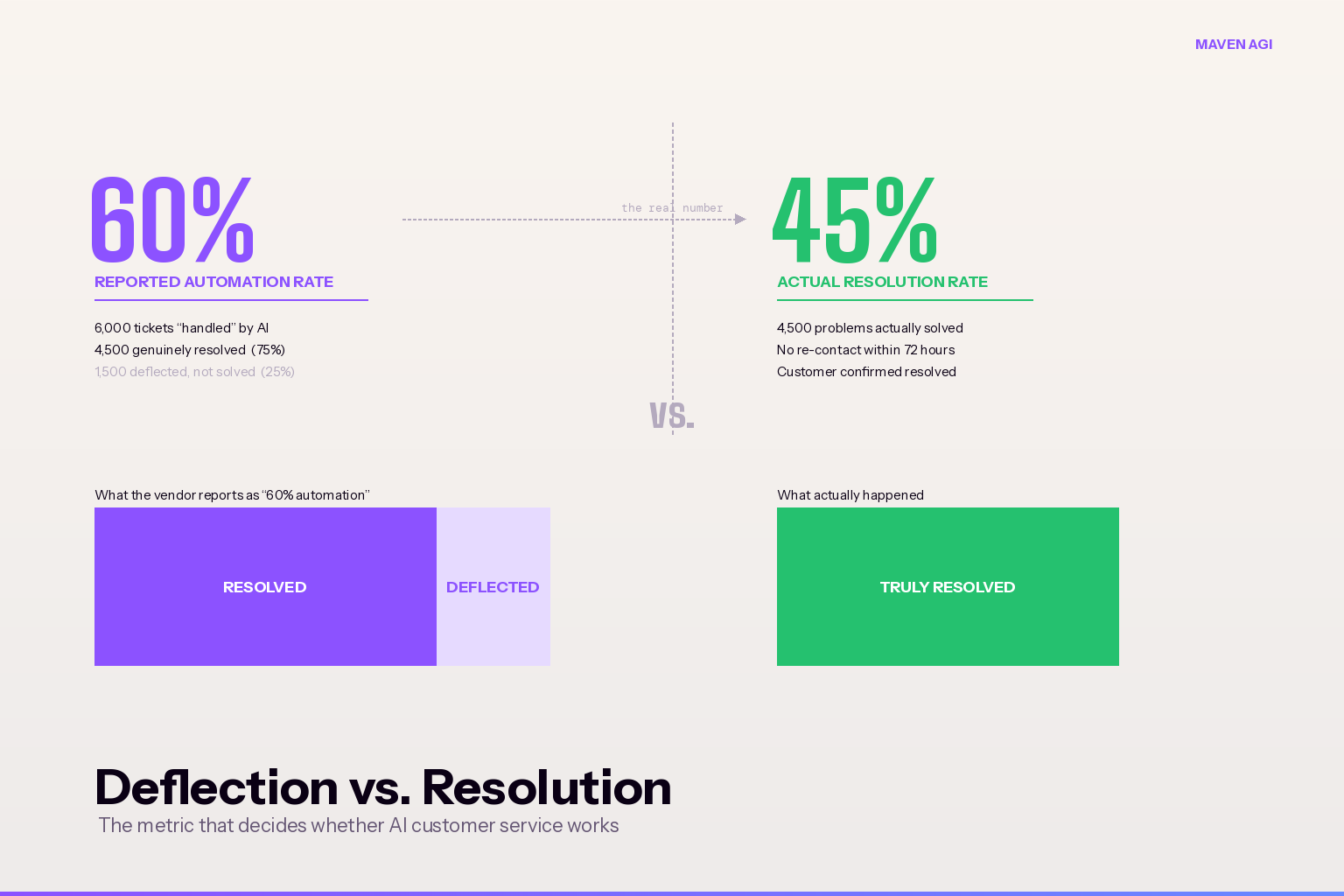
Your AI handles 10,000 tickets. The vendor dashboard shows a 60% automation rate, so 6,000 tickets were handled without a human. Strong on paper.
Dig into the data, though. Of those 6,000 automated interactions, maybe 75% were genuinely resolved. The customer got what they needed and didn’t come back. The other 25% were deflected: the AI responded, but the problem persisted. Some of those customers tried a different channel. Some called. Some left.
Your actual autonomous resolution rate isn’t 60%. It’s 45%. And the 1,500 tickets that looked automated but weren’t are still in your system, disguised as re-contacts, escalations, or churn.
One way to catch this is to measure resolution durability: not just whether an issue was marked resolved, but whether the customer came back about the same problem within 72 hours. A high deflection rate paired with a high re-contact rate isn’t automation. It’s cost deferral.
What resolution looks like in production
Autonomous resolution means the AI fully solved the customer’s problem with no human involvement, no follow-up ticket, and no second attempt through another channel. That is a higher bar than most vendor dashboards are built to measure, and it is the bar that correlates with the outcomes CX leaders care about: lower cost per ticket, higher CSAT, less churn.
Three things have to be true for an AI interaction to count as a genuine resolution.
The AI needs access to your systems, not just your knowledge base but your order management, billing, CRM, and ticketing tools. A customer asking to change a shipping address doesn’t need a link to your help center. They need the address changed. An overlay architecture that connects to your existing helpdesk, rather than replacing it, is what makes that access possible without a months-long migration. If the AI can read your systems but can’t write to them, it can answer questions but can’t solve problems. That is a sophisticated FAQ, not an AI agent.
The AI needs to take the action. Processing a refund, rebooking a flight, updating an account: these are the interactions that drive resolution. The distance between platforms that surface information and platforms that execute transactions is the distance between deflection and resolution.
The AI needs confirmation that the customer agrees the problem is solved. This is the piece most platforms skip. They close the ticket when the AI responds, not when the customer confirms the issue is handled. Vendors that measure customer-confirmed resolution consistently see CSAT scores 15 to 20% higher than platforms relying on automated ticket closure.
When those three conditions hold, the numbers move. Independent 2026 service-operations research from McKinsey shows action-taking AI agents resolving at far higher rates than deflection-first tools, at a fraction of the per-contact cost of human handling. The gap is structural, not a matter of configuration.
What it looks like when it’s working
The production numbers back this up. Mastermind reached 93% autonomous resolution within six weeks of deployment. Not deflection, but issues closed without a human. Rho held a 95% CSAT while handling 12% more monthly contacts with no added headcount, because the AI was absorbing real volume rather than passing it along.
Those results share a thread: the AI was measured on what it resolved, and it was wired into the systems where resolution actually happens. Resolution rate, not deflection, is the number that tracks with what customers experience and what finance can see.
Five questions to ask during any vendor evaluation
If you’re evaluating AI customer service platforms right now, the deflection-versus-resolution distinction should be your first filter. Here is how to surface it in a demo or POC.
How do you define resolved? If the answer involves containment, deflection, or automation rate without specifying that the customer’s problem was fully solved, you’re looking at a deflection metric wearing a resolution label. Ask the vendor to distinguish between interactions the AI handled and issues the AI solved.
What’s your re-contact rate within 72 hours? This is the metric that exposes false resolution. If 25% of resolved tickets generate a follow-up within three days, the effective resolution rate is materially lower than the headline number. Vendors confident in their resolution quality will share it. The ones who hesitate probably haven’t measured it.
Can the AI take actions in my backend systems, or just surface answers? Read versus read-write integration is the architectural dividing line. An AI that can look up an order but can’t process a return will always have a lower ceiling on genuine resolution. Ask specifically about the depth of integration with your existing helpdesk, CRM, and order management tools.
How do you measure customer confirmation of resolution? Auto-closing a ticket after the AI responds is not the same as confirming the customer’s issue was handled. Ask whether the platform uses customer confirmation, follow-up surveys, or re-contact tracking. The methodology matters as much as the number.
Are you willing to price based on successful resolutions? Outcome-based pricing aligns vendor incentives with customer outcomes. If the vendor only wins when your customers’ problems actually get solved, they’re building for resolution. If they charge per seat, per ticket, or per message regardless of outcome, their incentive is volume, not results.
The metric shift is already happening
The industry is moving this way, even if slowly. Gartner predicts that by 2029, AI will resolve 80% of common customer service issues without human intervention. The word that matters there is resolve, not deflect. Some vendors are already restructuring how they bill, separating verified resolutions from contained ones and charging only for outcomes they can prove. That is a faster read on a vendor’s real incentives than any case study.
For CX leaders evaluating vendors this quarter, the deflection-versus-resolution distinction isn’t a philosophical debate. It’s a procurement filter. Vendors who measure resolution build products that improve resolution. Vendors who measure deflection build products that improve deflection. Your customers will know the difference long before your dashboard does.
If you’re running an evaluation right now, start with the five questions above, and check any vendor’s definition against what resolution rate actually measures. For why deployments that look good in a demo stall in production, the breakdown of the AI support pilot-to-production gap covers the metrics that separate the two.
See what autonomous resolution looks like against your own ticket volume. Book a demo and bring your hardest queries.

Don’t be Shy.
Make the first move.
Request a free personalized demo.