

The Support Leader's New Job Title
The best CX organizations are treating AI as a product, not a tool.
Something shifted in enterprise support over the last 18 months. It started quietly — a chatbot here, an AI copilot there, a few automated responses sprinkled into the ticketing workflow. But now? Every AI touchpoint your customers and reps encounter — the in-app prompts, the chat widget, the copilot suggesting responses — is a product surface.
Whether you treat it that way or not.
David Doyle, who leads Support & CX at ClickUp, put it perfectly: if you're leading Support today, you're also quietly becoming a product manager. The organizations that recognize this shift are pulling ahead fast.
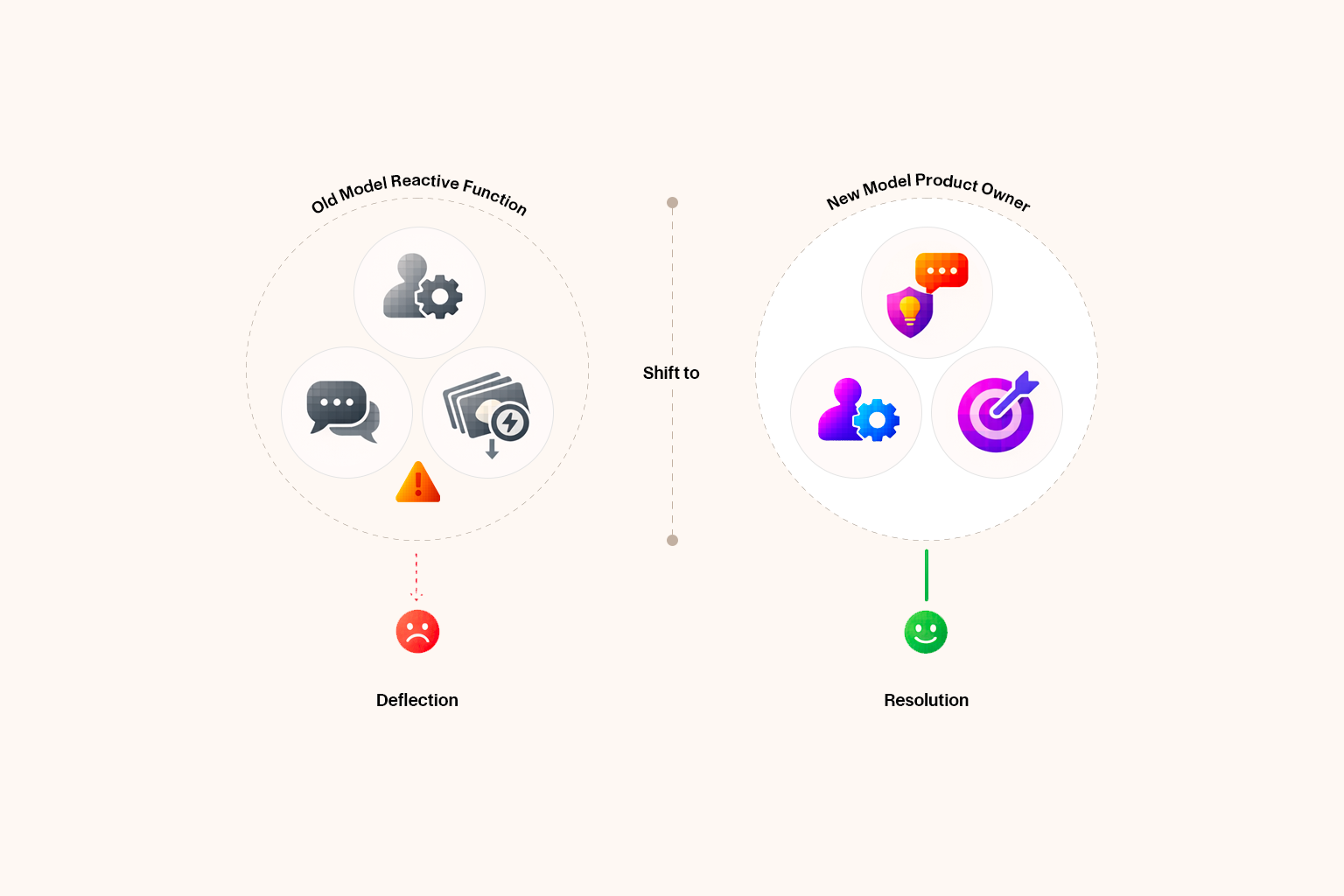
The Old Model: Support as a Reactive Function
For decades, the Support function operated in a predictable pattern. Product ships a feature, support learns about it (sometimes after customers do). Engineering builds a tool, support gets trained on it. Tickets come in, support reacts to them. Leadership asks for metrics, support reports handle time and CSAT.
The role was fundamentally reactive. Inherit tools, respond to volume, optimize within constraints someone else set. AI was supposed to make this easier, but somewhere along the way, something went wrong.
The Deflection Trap
Most AI support tools are optimized for one metric: deflection rate. 70% of customers didn't reach a human sounds great in a vendor pitch and looks great on a dashboard — but it answers the wrong question. Deflection only tells you the customer didn't escalate. It doesn't tell you whether they got their answer, left satisfied, quietly churned because the bot couldn't help, or found a workaround and never came back.
Deflection measures containment. Resolution measures outcomes. This distinction changes everything — from how you train your AI, to what data you feed it, to how you define success. The best Support leaders have stopped celebrating deflection. They've started obsessing over a different question: was the problem actually solved?
The New Model: Support as Product Owner
The CX leaders pulling ahead right now share a common trait: they've adopted a product mindset. Here's what that looks like in practice.
They define what success looks like before they ship. What does a successful interaction look like? What are the failure modes? What should the AI never say? When should it escalate versus attempt resolution? They're writing product specs, not training docs.
They partner with Product instead of just reacting to it. The old model: engineering builds it, support learns it. The new model: support shapes the flows alongside product and engineering. They're in the design reviews flagging edge cases before launch, not after. They're influencing the roadmap based on what they see in the queue. Support stops being downstream and becomes a co-creator.
They pick metrics that balance efficiency and experience. Efficiency metrics (handle time, deflection rate, cost per ticket) are easy to measure and easy to game. Experience metrics (resolution rate, effort score, repeat contact rate) are harder to measure but impossible to fake. The best CX orgs track both, and when they conflict, they dig into why.
They measure resolution, not just deflection. Resolution rate asks: of the customers who interacted with AI, how many had their issue fully resolved without needing a human? It's a harder bar and requires better AI and tighter feedback loops. But it's the only metric that actually aligns with what customers want — their problem solved.
The Question Every CX Leader Should Ask
If you lead Support or CX, here's the question worth sitting with: what would change if you treated your support surfaces as products you own, not tools you inherit?
Would you staff differently? Would you measure things differently? Would you have a seat at the table earlier in the product development process? Would you stop accepting AI tools that optimize for deflection and start demanding ones that optimize for resolution?
The support function is changing. The leaders who recognize they're now product managers — with all the ownership and accountability that implies — are the ones who will define what great CX looks like in the AI era.
Everyone else is just reacting to tools someone else built.

Don’t be Shy.
Make the first move.
Request a free personalized demo.